Victory At Last! #EndBadGovernance Activists ‘Treason’ Trial Cancelled

Pressure forces Nigerian Government to anabdon sham trial of Adaramoye Michael Lenin and 10 other #EndBadGovernance protestors charged with treason and terrorism

Today, December 10, 2025, Justice Emeka Nwite of the Federal High Court Abuja struck out the treason and terrorism charges against Adaramoye Michael Lenin and 10 others. In his ruling, Justice Emeka lamented that the prosecuting counsel had shown a lack of diligence and seriousness in the case they initiated against the protesters. Subsequently, Michael Lenin and his co-defendants, who were detained and put on trial over the August 2024 nationwide #EndBadGovenance protest against mass hunger, economic hardship and anti-poor policies of Bola Tinubu government, were acquitted. Other activists are Daniel Akande, Mosiu Sadiq   Adeyemi Abiodun Abayomi, Angel Love Innocent, Bashir Bello, Nuradeen Khamis, Buhari Lawal, Opaluwa Eleojo Simeon, Suleiman Yakubu. Abdulsalam Zubairu.

Since the arraignment of the 11 #Endbadgovernance protesters on September 2, 2024, after unlawfully spending many weeks in police cells and prison, the Nigerian government had wasted public resources to sustain charges of treason and terrorism against them without being able to prosecute their own case. Rather, the police prosecutors repeatedly employed different delayed tactics and sought adjournment after adjournment. At least all of them were eventually given bail and freed from prison.

We recall that on June 25, 2025, Justice Emeka warned the prosecuting counsel to desist from further delaying the trial and expressly stated that the case would be struck out if the police further attempted to postpone the trial, following the resilient agitations of the legal representatives of the activists. The judge was actually compelled to strike out this case due to the relentless campaign of our comrades and supporters locally and internationally. Repeatedly public protests were held around the world while trade unions and civil rights organisations demanded this trial stopped. It was the same pressure that forced the government and police to abandon the trial as the police prosector was absent in court today. Left to the government and police, they were prepared to perpetually tie the treason trial around the neck of the #EndBadGovernance activists in order to serve as deterrent to further mass protests against its anti-poor policies and attacks on democratic rights.

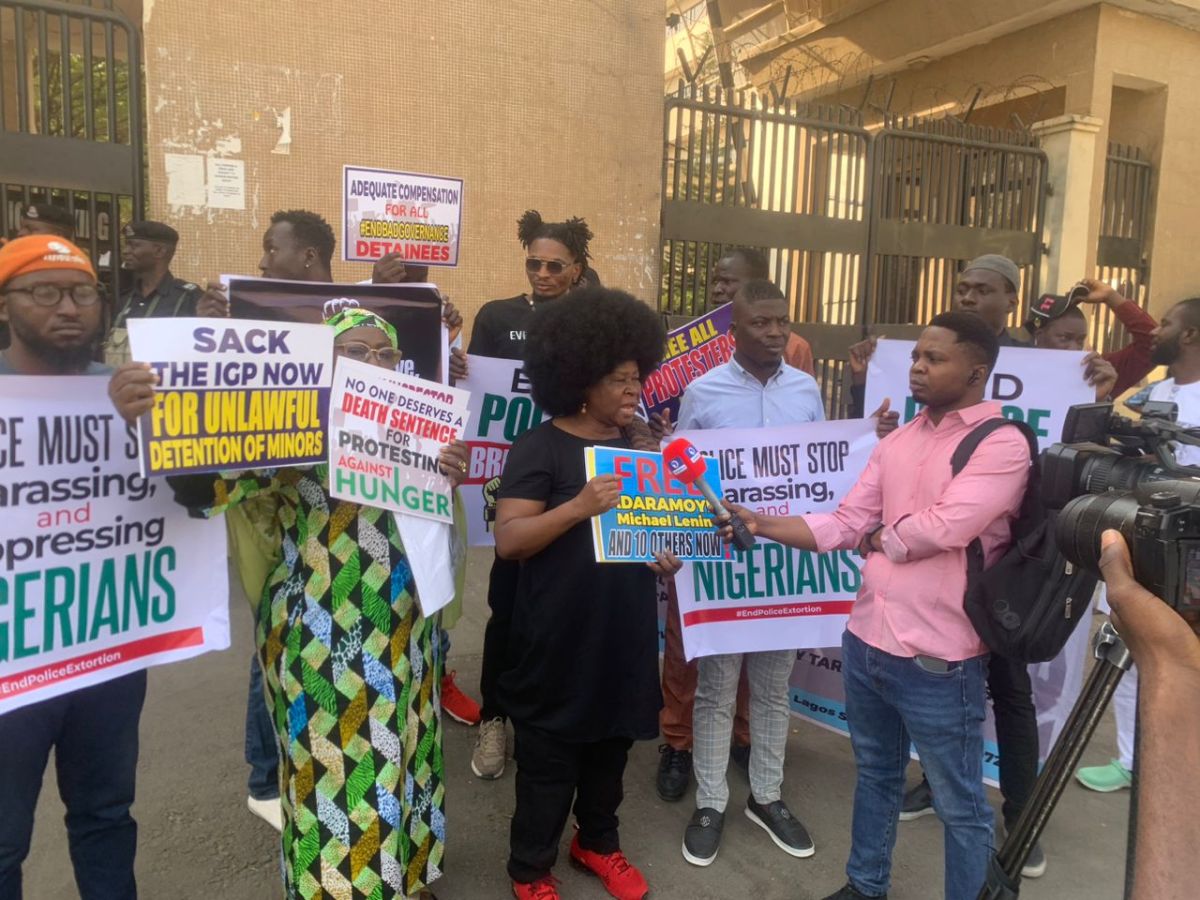
It is fitting and instructive that the news of the court victory came when activists were again on the streets of Lagos, Ibadan and elsewhere in Nigeria to use the occasion of the December 10 World Human Rights Day to highlight and put on the front burner the demand for an immediate end to the sham trial of 11 #Endbadgovernance activists and an end to other instances of attacks on democratic rights in Nigeria. The Youth Rights Campaign (YRC) expresses a profound appreciation to all the lawyers who rendered free legal service and comrades, supporters and activists locally and internationally for their sustained pressure and unflinching support throughout the periods of arrest, detention, and trial.

We consider this a victory, not just for the 11 #Endbadgovernance activists, but also for all Nigerians desirous of a better society. This is an example that we can fight and defeat a tyrannical government like the Tinubu government. Nigerian working people and youths must continue to fight consistently against bad governance and pro-capitalist policies of the government.

The Youth Rights Campaign (YRC) demands a public apology from the Nigerian government to all acquitted #Endbadgovernance activists, return of the properties and unfreezing of the bank accounts. We also demand adequate compensation for the 11 activists and all victims of abuse during and after the #Endbadgovernance protest. We also demand the immediate freedom of all the jailed #Endbadgovernance protesters sentenced to seven years imprisonment in Borno and withdrawal of charges against anybody still on trial over the August 2024 #Endbadgovernance protest. We maintain that protest against anti-poor policies and bad governance is a democratic right and must not be criminalized.

Francis Nwapa

National Secretary

YRC email: youth_rights@yahoo.com

Drop Sham Charges and End Treason Trial of #EndBadGovernance Activists

Treason Trial of Michael Lenin and 10 Others Comes Up Again on October 9 at FHC Abuja

Again, on Thursday October 9, Adaramoye Michael Lenin and 10 other activists are expected to appear, for the fifth time, before the Federal High Court in Abuja for a treason trial as a result of their participation in the nationwide #EndBadGovernance protests in August 2024. We of the Youth Rights Campaign (YRC) believe that what the activists are facing is a sham trial as protest against anti-poor policies is not tantamount to treason.

We therefore demand that the government withdraws the trumped-up charges preferred against these #EndBadGovernance protesters who are currently on bail with stringent conditions after having been incarcerated for at least two months both in the police custody and prisons. The other activists are Daniel Akande, Mosiu Sodeeq, Adeyemi Abiodun Abayomi, Suleiman Yakubu, Opaluwa Eleojo Simeon, Angel Love Innocent (female), Buhari Lawal, Bashir Bello Nuradeen Khamis and Abdulsalam Zubairu.

We strongly believe that the government cannot prove the charges against the activists as they are ridiculous and frivolous. For instance, the police in their charge sheet state that the activists committed treason, which carries a death penalty, because they carried a placard with a message: “End Bad Government”.

We believe that the inability to prove the charges is the reason the government has continued to employ delayed tactics in this case, something in which the trial judge, Justice Emeka Nwite, appears to be complicit. Since last November when the trial was first scheduled, it was only on the last adjourned date of June 25 that Judge himself was available in court, having been absent three times previously. Even at the said last sitting, there was no trial as a lawyer who appeared as the new police prosecutor, in order to further waste time, requested more time to study the case. We challenge Justice Nwite to fulfill the promise he made in the court on June 25 that he would strike out the case if the prosecutor further delays the trial.

It is not out of place to conclude that as part of its wider policy of criminalizing dissent, the government is determined to tie the treason trial around the neck of the #EndBadGovernance activists in order to serve as deterrent to another mass protest against its anti-poor policies.

Therefore, we call on civil society organisations, human rights groups, socialist and left groups, trade unions, activists and individuals of good conscience, in Nigeria and internationally, to support the demand for dropping of charges against the eleven #EndBadGovernance activists on trial in Abuja, and others across the country on similar sham trials, in order to totally regain their freedom. There should be also demands for an end to attacks on democratic rights and reversal of all anti-poor policies, which were the reason for the nationwide protest in the first place.

We commend individuals and groups, locally and internationally, who have been part of the struggle and solidarity for freedom for #EndBadGovernance activists since August 2024. We call for continued solidarity actions until there is total victory.

Francis Nwapa

National Secretary,

Youth Rights Campaign (YRC)

Email: youth_rights@yahoo.com

One Year of the ‘Treason Trial’

(IMAGE: Adaramoye Michael Lenin)

Today, September 2, 2025, marks exactly a year since the Tinubu government arraigned Adaramoye Michael Lenin and nine other #EndBadGovernance protesters over their role in the #EndBadGovernance protest, which took place between August 1 and 10, 2024. Michael Lenin – National Coordinator of YRC, Mosiu Sodiq, Angel Love Innocent, Buhari Lawal, Adeyemi Abayomi, Eleojo Opaluwa, Nurudeen Khamis, Bashir Bello, Suleiman Yakubu and Abdulsalam Zubairu were detained for weeks at a notorious detention centre of the Police in FCT Abuja, popularly known as Abattoir.

False and outrageous charges were levelled against them, including treason, terrorism, and mutiny, among others. Consequently, they were remanded in prison and were only granted bail on stringent conditions after 9 days. In fact, most of them had to spend about a month in jail because they couldn’t meet the bail conditions easily. Importantly, they were re-arraigned on September 17, 2024, with another detained protester, Daniel Akande, added to the defendants.

The Youth Rights Campaign (YRC) uses this opportunity to demand the immediate dropping of these nefarious and false charges against #EndBadGovernance protesters. After a year, the prosecutors have not provided any evidence to support their claims of treason, terrorism, etc. In fact, the case has suffered several adjournments. This delay tactic is to ensure the charges of treason and terrorism continue to be hung around the necks of these activists; this is inline with the antics of the Tinubu government to criminalize dissent. We also call on civil society organisations, youth groups, trade unions, individual activists and people of good conscience to support the demand for the immediate withdrawal of the sham charges and carry out different solidarity actions like issuing public statements, sending protest messages and organizing peaceful demo on or before October 9 which is the next date for the adjourned treason trial at the Federal High Court Abuja.

We also seize this opportunity to reiterate our call for the release of seven #EndBadGovernance protesters who were recently convicted in Borno state and sentenced to prison. We strongly believe that no Nigerian should be sent to prison or punished for exercising their fundamental rights to protest. The judiciary must not become the bride of despotic politicians or offer itself to be used to undermine basic human rights.

The Youth Rights Campaign (YRC) also calls for freedom for all who are still in detention or on trial in connection with #EndBadGovernance protest.

The Tinubu government has continued to act true to its draconian nature; the attacks on the fundamental rights of Nigerians are still ongoing. In fact, cases of police brutality have become a daily occurrence. Alongside this calamitous situation is the continuation of the neo-liberal and anti-masses polices. None of the demands made by Nigerians during the #EndBadGovernance protest has been met by the government; it ignored them all. To respond to this, we need a united mass platform of resistance, uniting all oppressed layers of society, particularly the working masses. We urge the labour leadership to wake up to its responsibility and lend its weight to the building of mass resistance against repression and anti-poor policies under the Tinubu government.

  • We demand the immediate and unconditional dropping of all charges on Michael Lenin, and other #EndBadGovernance protesters
  • We reiterate our call for the immediate release of seven unjustly convicted #EndBadGovernance protesters in Borno and all protesters still in prison
  • We demand justice for all Nigerians killed and injured during the #EndBadGovernance protest
  • Working people and youth must unite against attacks on democratic and anti-poor policies of the Tinubu failed government

Youth Rights Campaign (YRC), Nigeria

Nepal: Mass Protests Topple Sharma Oli

Can The Struggle Be Taken Further?

Yet again, Nepal is witnessing another historic movement; the days when decades happened. Thousands of protesters, mainly young people, took to the streets to protest against the ban on social media platforms by Prime Minister Sharma Oli. The ban on social media platforms like Facebook, TikTok, YouTube, etc., was imposed on September 4. For young people who have endured an existence of mass misery, joblessness, and hopelessness, the ban on social media platforms became the last straw to break the camel’s back.

By Michael Lenin

National Coordinator, Youth Rights Campaign and member, Democratic Socialist Movement

Anger began to boil against the administration of Sharma, and on Monday, September 8, this anger translated into a mass movement. In what has been tagged as a “Gen Z movement” by commentators and mainstream media, the protest involving tens of thousands broke out in several cities and towns of Nepal. Protests occurred across Nepal, from Kathmandu to Pokhara, Birgunj, Biratnagar, Bharatpur, and other cities, with significant turnouts.

REPRESSION RESISTED

The immediate response of the regime was heavy repression of the protest. Reports indicate that about 19 people were killed by security agents on the first day of the protest, while hundreds were injured, although there are indications that the death figure could be higher than 19. In the face of heavy repression, the protest took a different turn and grew stronger; they successfully resisted the repression. On September 9, not only was the ban on social media lifted, but Prime Minister Sharma Oli, who had planted the thorns that pierced him, resigned as Prime Minister. Sharma Oli, who had imposed a ban on social media against the people, was sent packing within two days of mass movement!

BEYOND THE BAN

Importantly, the ban on social media platforms was not the only fuel that drove mass anger against Sharma; in fact, it was merely a detonator of the anger. Since returning to power last year, Sharma had provoked the anger of the masses. Many of his acts of high-handedness generated mass anger, but he was never challenged on the streets. This gave him the overblown confidence that he and his cronies could continue to have their way. For instance, Sharma unleashed several attacks against NGOs and civil societies in Nepal, stiffened the civic space, used the CIIA (an anti-corruption agency) to witch-hunt his opponents, and appointed his cronies to key positions.

Being among the ruling cabals became a license to a life of opulence. Together, they all lived happily while thousands of Nepalese citizens lived in misery. By estimation, over 20% of citizens live in extreme poverty. Youth unemployment as of 2024 stood at 20.84%, while over 700,000 youths yearly seek to work outside the country in search of greener pastures. The employment program initiated by Sharma this year successfully employed just about 3,300 out of over 800,000 who applied. This reflects the agonizing situation of the masses of Nepal and the background to the mass anger. These are the crimes of Sharma Oli that the Nepalese youth are determined to punish him for. But these are not just the crimes of Sharma; they are the inevitable reality attached to capitalism.

In 2006 Nepal witnessed a revolution which swept away the old powers, including the monarchy. The last King had attempted to impose direct rule in 2005, the resistance to this led to the revolutionary developments and, in 2008, an elected Constituent Assembly formally abolished the monarchy and declared Nepal a republic. Despite their mass support and heading different governments the rival Communist Parties, which politically are different variants of Maoism, either collaborated with the capitalists or effectively prevented a break with capitalism. This was because, unlike Lenin and the Bolsheviks in the 1917 Russian revolution, they did not have a clear socialist programme to offer workers, youth and the oppressed nationalities.

The result was that the capitalists were given room to regroup and Nepal, like other third-world countries, remained trapped in primitive production conditions and is unable to progress. For instance, a large part of the GDP, about 30%, comes from foreign remittances, while over 60% of production is in the agriculture sector. In fact, there is very little potential for youth to work without being confined to farmlands with hoes in their hands.

POWER AND FIRE

The mass movement continues, and the cities of Nepal are soaked in flames from burnt houses and properties of corrupt politicians. Power has left the walls of government buildings; it now resides with the mass of angry protesters. A video of the Hilton hotel, an abode for corrupt politicians to lavish money on merriment, circulated on social media; fire and flames had consumed it, burnt down by angry protesters. Many politicians have now abandoned their homes and fled. Without a Prime Minister, without the parliament, and with the flight of political officeholders, the institutions of repression—the police, law courts, and prisons—have become paralyzed. The police, without a “state” to be loyal to, are non-existent. The question is who will fill this vacuum?

YOUTH UPRISING: WHERE IS THE PLACE OF THE WORKING CLASS?

This is an era of youth-led mass movements, where young people are left with unanswered questions about why their lives remain a sad story of poverty and misery, and a future that grows bleaker daily. There has been a wave of youth mass movements in many African countries. This “Gen Z” uprising in Nepal, a country in Asia, shows how wide and fierce the fire of resistance can spread. In Kenya, the protest of the youth successfully forced the Ruto government to reverse the finance bill, though the regime doubled down on its repression of protesters. In Nigeria, the EndBadGovernance protests challenged the Tinubu government and the ruling class. Although unable to win a major concession, the movement showed that mass resistance against a despotic government is possible.

What is significantly missing in the recent uprising of youth is the power of the working class. The 2006 revolution saw workers’ general strike action. Today, although workers are sympathetic to these mass movements and sometimes even join at the barricade, the question of workers’ power is not merely in sympathy with a mass movement or in the direct participation of one or two members or even a thousand workers. The power of the working class in a mass movement lies, as Leon Trotsky would put it: “The force of mass movements lies not in their numbers, but in the transformation of the workers’ consciousness, in their ability to act as a class.” And in all of the youth mass movements, this consciousness of the working class—the ability of the workers to act as a class—is apparently missing. However, this is not because workers are not prepared to struggle or challenge dictatorial capitalist regimes; it lies in the failure of leadership. Indeed, “The historic crisis of mankind is reduced to the crisis of the revolutionary leadership.”

A PROGRAMME FOR SOCIALIST REVOLUTION IN NEPAL

Today in Nepal, a revolutionary situation exists. How far this can go depends on many factors. But for the uprising to transform into a socialist revolution, the key forces of the working class and the peasants must enter the arena of this movement. The movement must move forward, from a movement of youth to a movement of the entire oppressed class.

Power in Nepal is dangling in the air. If the revolutionaries are not organized to take it, the counter-revolutionaries will. Therefore, this movement can only take two steps forward into a socialist revolution or retreat into a loss. The existence of a revolutionary party of the oppressed, capable of unifying the oppressed forces under one single banner, capable of leading the onslaught against capitalism—a party with clear ideas of socialism and concretely how to achieve it—is essential. Sadly, this important feature is non-existent. If the people don’t take power, it will be taken from them; power cannot dangle in the air for long.

In this regard, without an organization of the oppressed, armed with clear ideas of scientific socialism, with great experience in struggle and ready to lead the onslaught, the struggle for socialism in the present uprising in Nepal faces an impediment.

A SOCIALIST REVOLUTION IS POSSIBLE

The struggle in Nepal has shown with absolute clarity that the conditions for the development of revolutionary situations exist. It is not yet an end of history, as defenders of capitalism would want the people to believe. Whichever way the ongoing movement in Nepal finds itself, it has successfully ignited discussions on revolutionary and socialism around the world. The ruling class of the world are once again reminded that each of them sits on ticking time bomb. The development of humanity, a complete shift from capitalism is possible. The genuine forces of socialism also have a great role to play in the unfolding situation globally. The role of uniting the forces of oppressed and organizing the anger of the falls more on socialist revolutionaries especially in a period of lack of militant working class leadership.

June 12: Protesters Call for Sustained Resistance against Tinubu’s Anti-Poor Policies and Attacks on Democratic Rights

On June 12, protests were held in a few states across the country as a continuation of an expression by the working masses and youth of their rejection of the anti-poor capitalist policies of the Tinubu government and its descent into civilian dictatorship with attacks on democratic rights. In other words, the conduct and action of the Tinubu government, which celebrates June 12 as “Democracy Day”, runs contrary to the ideals of the day which was a watershed in a protracted struggle of Nigerians to end military dictatorship and enthrone a democratic rule with the hope of better living standards. However, it is apposite to state that on the basis of bourgeois democracy and economic programme, especially in a neo-colonial country, there was no guarantee that June 12 election won by MKO Abiola would have heralded better living standards for the vast majority.

Protesting in Lagos

Members of the Democratic Socialist Movement (DSM) joined socialists and civil society activists to organise protests in Lagos, Oyo and Osun states. The turnout was small compared to the recently past nationwide protests, for instance the last October 1 protest, not talk of the #EndBadGovernance protests in August 2024. For instance, Lagos which recorded the biggest outing had just about 300 protesters.

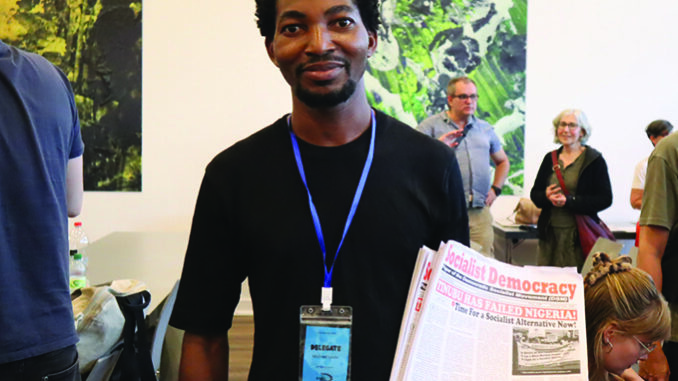
However, the protests, which were energetic and inspiring, enjoyed massive support from passers-by, bystanders, motorists and residents of areas the protesters passed. This underscores the fact the vast majority of working people and youth remain vehemently opposed to the Tinubu government and its policies. Indeed, this is reflected, in Lagos for instance, in an impressive sale of Socialist Democracy, the paper of the DSM. with a frontpage headline: “Tinubu Has Failed Nigeria”, with the majority of the copies sold being bought by those on the sidelines of the protest. It actually shows that the assertion of the headline resonates with most Nigerians on whose living standards and livelihood the capitalist policies have had devastating effects. For instance, a journalist who bought the paper in Ibadan used the image of the front page with the headline to illustrate the feeling of many Nigerians on the failure of the government in an open letter he did to Tinubu on social media.

H. T. Soweto speaking in Lagos

The relatively small turnout at June 12 protest is most likely because the past actions were not able to force the Tinubu government to reverse the ruinous policies coupled with its sustained attacks of democratic rights attacking as a deterrent to any resistance and opposition to the policies. Therefore, many chose not to expend their time and energy on the protest but rather faced their daily struggle for survival. The leadership of the labour movement deserves the most blame for this situation. If they had not refused to put forward organised labour as a platform for a serious mass resistance against the anti-poor policies, some real concessions could have been won if not an outright reversal. We therefore reiterate the call on workers and trade union activists to mount a sustained pressure on the labour leadership to organise a serious struggle, for instance, a 24-general strike and mass protest as the first step, against the anti-poor policies of the Tinubu government. Despite a legitimate lack of trust in the leadership of labour by the working people and youth because of the past betrayal a serious mass mobilisation can draw massive supports for a general strike and bring several thousands on the street.

Protesting in Ibadan

Therefore, the resolve of the working people, youth and activists who have sustained the resistance in the face of a depressing mood, the indolence of labour leadership and the intimidation of the Tinubu government is commendable. They have helped put on the front burner the feeling and position of the vast majority who are firmly against the anti-poor policies despite the propaganda of the government.

The protest despite its size also served as a bold statement and warning to the Tinubu government it is not a walkover for it. The government had to organise a counter protest in Lagos and deploy the police to attempt to intimidate and disorient the anti-government protesters. Besides, given a deep-seated mass anger against the government, it is not ruled out that a spark could provoke a tumultuous revolt before the next general elections.

The support of the Nigeria Bar Association (NBA) Ikeja branch for the protest in Lagos is commendable. Before the protest they sent a letter to the state Commissioner of Police warning him against any plan to violate the rights of the protesters and did a fantastic report, which was widely circulated, after the protest highlighting the unprofessional conducts of the police including their expected bias towards the pro-Tinubu protesters.

Many copies of Socialist Democracy were sold.

Altogether, tens of thousands copies of separate leaflets issued by the #EndBadGovernace Lagos State, Joint Action Front (JAF) and DSM were widely circulated before and during the protest. The leaflets and also various placards in these protests generally call for the reversal of the anti-poor policies, end to attacks on democratic rights, dropping of trumped-up charges against Michael Lenin and others still on sham trial in connection with the #EndBadGovernace nationwide protest of August 2024, a serious tackling of the deepening insecurity etc. The materials of both the DSM and JAF in addition argue for why the working people and youth in addition to sustaining resistance against the anti-poor policies must also support building of a mass working people party on a socialist programme.

TINUBU HAS FAILED NIGERIA

Time For a Socialist Alternative Now!

On May 29, 2025, President Bola Ahmed Tinubu would clock two years in office. In that space of time, his neo-liberal capitalist economic reforms have led to a destruction of livelihoods and the economy on a scale previously unimagined.

By H.T Soweto, lead article ‘Socialist Democracy’, May-June 2025 edition 

For example, the pump price of petrol which Tinubu met at N197 per litre when he came to power on May 29, 2023 now hovers around N800 to N900 per litre – a marginal drop from its peak of around N1,100 per litre last year. The naira has also sharply depreciated from N463/$1 in early May 2023 to nearly N1600/$1 as at April 2025. Within the same period, headline inflation rate rose from 23% in April 2023 to 35% in December 2024 – the highest in the last three decades! On the same score, food prices are more than 80% higher than when the election was held.

These are the consequences of the IMF and World Bank neoliberal capitalist reforms, otherwise known as the “Renewed Hope Agenda”, that President Tinubu chose to implement as soon as he took power. In implementing these policies, Tinubu and the ruling All Progressive Congress (APC) had promised that they would lead to prosperity for Nigeria. Two years after, none of the promises has materialized. Instead, the neo-liberal reforms have resulted in greater inequality, hunger and deepening poverty.

TWO YEARS OF BLUNDER

Even from a capitalist point of view, Tinubu’s decision on May 29, 2023 to withdraw fuel subsidy and then shortly after, to devaluate the naira, is nothing short of a blunder. It is no hidden secret that crude oil is the elixir of Nigeria’s neocolonial economy. While only contributing between 5 to 10 percent to the overall GDP, it accounts for nothing less than 80% of national revenue and 90 percent of foreign exchange earnings. Everything – from economic production, to transportation, lighting of homes and offices as well as cooking – runs on affordable petrol and other derivatives from crude oil.

In the same vein, Nigeria’s currency devaluation is unarguably one of the largest adjustments anywhere in the world. Within a few weeks, the naira shed about 70% of its value. Only the Ethiopian currency, birr, has seen a bigger move recently. By tinkering with the oil subsidy which had kept fuel within affordable limits while also devaluing the naira, Tinubu opened the door to a catastrophe. Clearly Tinubu and the clique around him gambled that these moves would have a better outcome than the result of Buhari’s mixture of austerity and attempts to support different economic sectors.

However, the result of Tinubu’s neo-liberal policies is that high inflation, forex volatility and surging production costs have become the defining feature of the economy over the past two years. This has impacted Nigeria’s manufacturing sector causing a contraction. As data shows, the sector’s contribution to the GDP decreased from 8.42% in the third quarter of 2023 to 8.21% in the same period last year while the sector’s growth rate also slowed on the back of weakened consumer demand, escalating production costs, and declining purchasing power. This has forced several multinational firms to relocate out of the country even as others have closed shop. Indeed, an 87.5% surge of unsold inventory running into N2.14 trillion was recorded for the year 2024 compared to 2023, a report of the Manufacturer Association of Nigeria (MAN) has shown.

One of the consequences of naira devaluation is the improvement in Nigeria’s balance of payments as well as increase in national revenue. As the value of the currency has fallen, Nigeria’s dollar earnings from oil and gas sales, customs and excise duties, VAT and corporate income tax have all increased exponentially. This, together with the removal of oil subsidies, has caused a narrowing of Nigeria’s fiscal deficit from 6.4% of GDP in early 2023 to 4.4% in early 2024. Also, for the first time in many years, Nigeria’s has recorded a trade surplus while Nigeria’s foreign reserves now exceed $40 billion.

But these gains have been made at the cost of near destruction of the economy. As we write, more than half of Nigeria’s total Gross Domestic Product (GDP) has been wiped off over the past two years that Tinubu came to power. Despite the picture of growth that its naira-denominated variant portrays, the country’s GDP in dollar terms has actually declined from $363.82 billion in 2023 to $188.27 billion in 2025.

They are also unstainable gains. At some point, currency devaluation can result in an opposite effect one of which is encouraging capital flight in the form of companies and individuals finding ways to repatriate their wealth out of the country. Moreso, whatever macroeconomic stability has been achieved through the reforms now face headwinds from a global capitalist economy in turmoil.

WORLD ECONOMY IN TURMOIL

Since President Donald Trump came into power at the Oval Office in the US, his administration has become the great accelerator of all the contradictions of the global capitalist order. The developing trade war, provoked by Trump’s imposition of tariffs in April, has led to ripples in stock market and crash in crude oil price on the world market.

From its peak in January, Brent crude, the international oil benchmark, has dropped 19.31%. This poses grave consequence for commodity exporters like Nigeria. This explains why the International Monetary Fund (IMF) has now cut its growth forecast from Nigeria from 3.2% to 3%. This is expected to slow further to 2.7% next year. Although marginal, this speaks to the fragility of Nigeria’s economy two years into the reform.

Nigeria’s 2024 budget forecast oil at $75 a barrel but crude oil has slumped to around $66. One of the immediate impacts for Nigeria would be a decline in revenue. This will have the effect of reversing any gain in fiscal balance that the government reforms have reportedly achieved. The IMF estimates the country’s current account balance will shrink from 9.1% of GDP last year to 6.9 per cent in 2025.

This is on top of the warning by the US investment bank JP Morgan that Nigeria could slide into a current account deficit if the decline in oil prices is sustained. Lower oil price also means lower foreign exchange earnings. This will cause further instability in the foreign exchange market with the possibility of the dollar exchanging for as high as N2, 000 in a short period of time. Presently, the British pound has crossed the mark as it already exchanges for over N2, 000 to a naira.

Reduced revenue may also make it more difficult for Nigeria to service its existing debt, further straining its finances. As of March 2024, Nigeria’s total public debt stood at N121.67 trillion ($91.46 billion) – an increase of N24.33 trillion from December 2023. Debt servicing consumed 47%, N13.12 trillion, of the Federal Government’s total expenditure in the first nine months of 2024, highlighting the significant burden on the nation’s finances. Any significant shortfall in revenue therefore poses an even greater catastrophe than what has been experienced in the last two years.

GROWING INSECURITY

A feature of Tinubu’s two years in power is the regime’s cluelessness in the face of the growing insecurity across the country. Nigeria’s countryside, from the East to the North, is practically in a state of war.

In the North east of the country, Boko Haram and the Islamic State of West African Province (ISWAP) have increased their attacks. Their two-pronged assaults on military bases in Borno state and alongside Nigeria’s border with Cameroon between 24 and 25 March 2025 introduces a new frightening dimension to the conflict. Eye witness accounts suggest that the Islamist militants utilized armed drones in the attack. This could mark a new stage in a conflict that has lasted over ten years leading to about 30, 000 deaths while displacing about two million people.

In the Middle belt and towards the South, the violent actions of bandits and kidnappers have also continued. In the South East of the country, the agitation by the Indigenous People of Biafra (IPOB) as well as Eastern Security Network (ESN) has not abated. Curiously, the regime continues to hold the separatist leader, Nnamdi Kanu, in prison even when his continuous detention is a crucial element provoking the violence. Neither has the perennial violent conflict between herders and farmers stopped. This year has already witnessed a certain deterioration in the historical conflict over land and water resources. Alongside this is a high risk of a religious war breaking out due to how the violence is stoking religious sentiment.

Tension is high in most communities while security forces have been accused of failing to protect villagers from attacks. At least, 13,346 people were killed and over 9,207 abducted within the first one year of Tinubu’s administration. Sadly, the major conflict-zones are concentrated in states which account for most of Nigeria’s food production. Consequently, the rampaging insecurity is part of the major factors driving food inflation in the country.

WE CANNOT CONTINUE LIKE THIS

Despite all the movement in inflation, income growth for the rest of the working population remains weak reflecting limited gain in living standards over the past two years. From a GDP per capital of $2, 200 in 2022, Nigeria’s GDP per capita declined to $835 in 2025 highlighting how much toll Tinubu’s reforms have taken on the masses. In the same vein, wages have stayed abysmally low relative to the rate of inflation. Indeed, when the dollar value is considered, the current N70, 000 minimum wage negotiated by trade unions last year has the same purchasing power as Nigeria’s wage of N125 four decades ago!

Aside shelter, food and transportation are crucial elements of a workers’ wage. Yet these are sectors showing some of the highest inflation increase in price. While food have seen an 80% increase in prices in recent times, transport fares for interstate travel rose by 403.5%, airfares rose by 280.7% on the average while water transport fares also rose by 148.8 percent rise over the past two years. As a report by Business Day Newspaper shows, three out of ten workers allocate over 20% of their salary to transport costs while over 50% of Nigerians spend almost all of their income on food alone.

The result is an ever-expanding arc of misery for the working masses and the poor. Indeed, some families now go without food as they cannot afford to have three square meals in 24 hours. Yet, a few billionaires have seen their wealth increase exponentially within the past two years showing the pro-rich character of Tinubu’s reforms. According to Forbes, billionaire Aliko Dangote has seen his wealth nearly double from $13.4 billion last year to $23.9 billion in January 2025, which ranks the Nigerian entrepreneur as the wealthiest person in Africa and 86th in the world. Three other billionaires, Mike Adenuga, Abdulsamad Rabiu, and Femi Otedola, have seen their wealth increase in the same manner.

Their combined wealth, derived from inheritance, monopoly power, and cronyism, is valued at $23.7 billion. This is an amount so vast that, according to Oxfam, it could easily cover the whole of Lagos city in 500-naira notes. In fact, Aliko Dangote alone could spend N1 million daily for 42 years without depleting his fortune! Meanwhile, over 133 million Nigerians, around 70% of the population, are struggling with hunger while thousands are dying because they cannot afford hospital bills.

Faced with an economic policy that is not working  increasingly Tinubu’s answer to both insecurity and opposition is repression. But this will not work because Tinubu’s regime is both a defendant and servant of the capitalist system whose failures are at the root cause of the issues. With the majority facing falling living standards while the multi-millionaire Tinubu regularly takes ‘working’ holidays in Europe resentment can only grow. Tinubu knows that under nine million actually voted for him and now he is fearful of the tens of millions of Nigerians that don’t support him, hence repression of protesters and suppression of music critical of him.

WHAT NEEDS TO BE DONE

165 years ago, Karl Marx noted that “there is something rotten in the very the core of a society that increases its wealth without diminishing its misery”. The extreme wealth inequality which are the result of Tinubu’s neoliberal economic reforms of the past two years is not only an indictment of Tinubu himself, it is also an indication that capitalism is broken and need to be replaced.

This raises the question as to whether there is no other way of running Nigeria other than the corruption, cronyism, exploitation and repression that have been the defining feature of governance over the past 6 decades. There is actually another way. That is through the Socialist reconstruction of Nigeria. This would require the working class coming to power and nationalizing the commanding heights of Nigeria’s economy like the oil and gas firms, big monopoly companies and banks and their placement under workers democratic control and management. Such a step backed by a socialist plan of development can begin to ensure that Nigeria’s economy is run to meet the needs of the people instead of the greed of a few billionaires.

It is also under such an arrangement that Nigeria’s insecurity can be tackled through the democratic resolution of the National Question which is a crucial factor behind the cacophonic agitations across the country.

To achieve this however means that the working people, youth, trade unions and pro-masses organisations have to step up the struggle against Tinubu’s anti-poor policies, for a living minimum wage, against repression while starting the crucial work of building a political vehicle, a mass workers party on a socialist program, to begin to fight to wrest political power from the hands of the capitalist gangsters holding the country to ransom and begin the socialist reconstruction of Nigeria.

May Day: No Plan for Concrete Action from Labour against Anti-Poor Policies of Tinubu Government

This year May Day held at a period when many workers and the poor are facing serious economic hardship compounded by the anti-poor capitalist policies of the Bola Tinubu government. Another feature of the government which will reach a midterm mark on May 29 is a ceaseless attack on democratic rights aimed at stifling resistance against its anti-poor policies.

Therefore, ordinarily the theme for this year’s May Day in Nigeria, ‘Reclaiming the Civic Space in the Midst of Economic Hardship’, is apt. However, the problem is that the Labour leaders who formulated such a fitting theme have not demonstrated any serious resolve to reclaim the civic space with a view to organizing and mobilizing mass resistance against the policies that breed the economic hardship. In other words, the Tinubu government is having a field day with its attacks on the living standards and democratic rights of the working people and youth because the leadership of labour have refused to initiate a serious fight back.

Selling ‘Socialist Democracy’ at the Lagos May Day rally

In their May Day speeches, the national leaderships of both the NLC and TUC did not lack correct words to describe the current situation. The problem remains translating them into concrete action. For instance, the NLC President Joe Ajaero did not just lament the fact that many states and private sector employers have not implemented the new minimum wage, he strongly asserted that “the [minimum wage] law must be obeyed. We must begin a fresh push for not just compliance, but also for a comprehensive wage review to mitigate the hardship faced by Nigerian workers.” Good speech. But unfortunately, it may end up as another hot air unless workers and trade union activists mount a serious pressure on the labour leadership to walk the talk.

Selling ‘Socialist Democracy’ at the Osun May Day rally

However, while in Abuja at the national rally, the labour leaders spoke radically, even if it was braggadocio, in many states as usual it was shameless praise singing and pat on the back for the governors. For instance, in Osun, the state chair of the TUC sponsored a big banner campaigning for governor’s second term. In Ogun state, labour leaders commended the state governor for the prompt payment of pension for retirees. However, this is half-truth and misleading. The state owes over N50 billion unpaid gratuities and has not remitted over N40 billion contributory pension funds which have been already deducted from workers’ salaries. However, in Oyo while the labour leaders commended the state governor for approving N80,000 as the minimum wage, they also noted that the implementation had not been extended to workers in the judiciary sector and state-owned tertiary institutions.

In Lagos, the National Association of Nigeria Nurses and Midwives NANNM boycotted the May Day rally but instead held a separate event at the union’s Secretariat. This was in protest against the reduction in the salaries of health workers in the state. We are of the opinion this was not a correct method. They should have taken the protest to the main rally. Instructively, the state chair of the NLC Funmi Sessi, incidentally a nurse by profession, did not mention the plight of the nurses and midwives in her speech at the rally which had in attendance the state governor.

Some of the DSM comrades at the Lagos May Day rally

Members of the Democratic Socialist Movement participated actively at the international workers’ day rallies in Abuja, Oyo, Osun, Ogun and Lagos with the May/June 2025 edition of the Socialist Democracy (SD), our paper and different special leaflets which articulated what workers and trade unions should do in response to various capitalist attacks by the government at all levels. 416 copies of the SD were sold and about 8,000 copies of leaflets were circulated. Some rally participants wished to stay in contact with the DSM.

YRC Condemns Third Postponement of #ENDBADGOVERNANCE Protesters ‘Treason’ Trial

TREASON TRIAL OF 11 #ENDBADGOVERNANCE PROTESTERS: DROP ALL THE CHARGES NOW

WE CONDEMN THE CONTINUOUS DELAY OF THE TRIAL AND THE PERSISTENT ABSENCE OF THE JUDGE

The Youth Rights Campaign (YRC) strongly condemns the continuous delay of the trial of Adaramoye Michael Lenin and 10 other #Endbadgovernance protesters who were charged with treason by the Tinubu administration over their involvement in the #Endbadgovernance protest which erupted last year August. We also condemn the persistent absence of the trial Judge, Justice Emeka Nwite of the Federal High Court Abuja, each time the case has come up for hearing in the last five months. As a result, the accused activists are yet to have their day in court over six months after they were charged. This delay has caused the accused activists enormous psychological and material strain. We hereby call on the Federal Government to stop wasting the time of the activists over a sham trial. Instead of wasting their time and taxpayers’ money any further, we hereby demand immediate dismissal of the false charges and a public apology to the 11 #EndBadGovernance protesters.

After overcoming the hurdles of a stringent bail conditions, the activists looked forward to the date for trial which was first set for November 8, 2024. Shockingly, the Judge, Justice Emeka Nwite, who set the date was absent on the day the trial was supposed to commence. Consequently, a new date of January, 29, 2025 was set. The activists, who had no reason to be scared of the trumped-up charges against them, had showed up in court, however, again it was no-show for the judge. The absence of the judge meant that a new date had to be agreed on. Hence, March 26 was chosen as a new date for the commencement of trial. Again, the Judge was not in court on this new date! The best explanation we have gotten so far is that the judge is on vacation. The baffling question is how a judge would fix and agree to date of court sitting on three different occasions and be absent? And how many vacations does a Judge take within six months? As far as we are concerned, this is a deliberate attempt to stall the trial and ensure the threat of a death penalty continues to hang on the neck of these innocent Nigerians. We condemn this ‘hide and seek’ gimmick.

We seize this opportunity to call for the dropping of all charges against the 11 #Endbadgovernance protesters charged with treason, and all other #Endbangovernance protesters across the country. We strongly believe that the trial is a ploy by the government not only to criminalize peaceful protest, but to deter Nigerians from protesting against the hardship and misery caused by the pro-capitalist policies of the Tinubu administration. It is important to add that the government through the Attorney General, Lateef Fagbemi, had discharged and discontinued similar suit of treason against 119 protesters who were mostly minors after their arraignment in court on November 1, 2024. That arraignment was a gory sight, many of the children had been starved and detained for weeks at different detention centers, including at Abattoir, the notorious police detention centre in Abuja where the 11 Endbadgovernance were also kept for weeks.

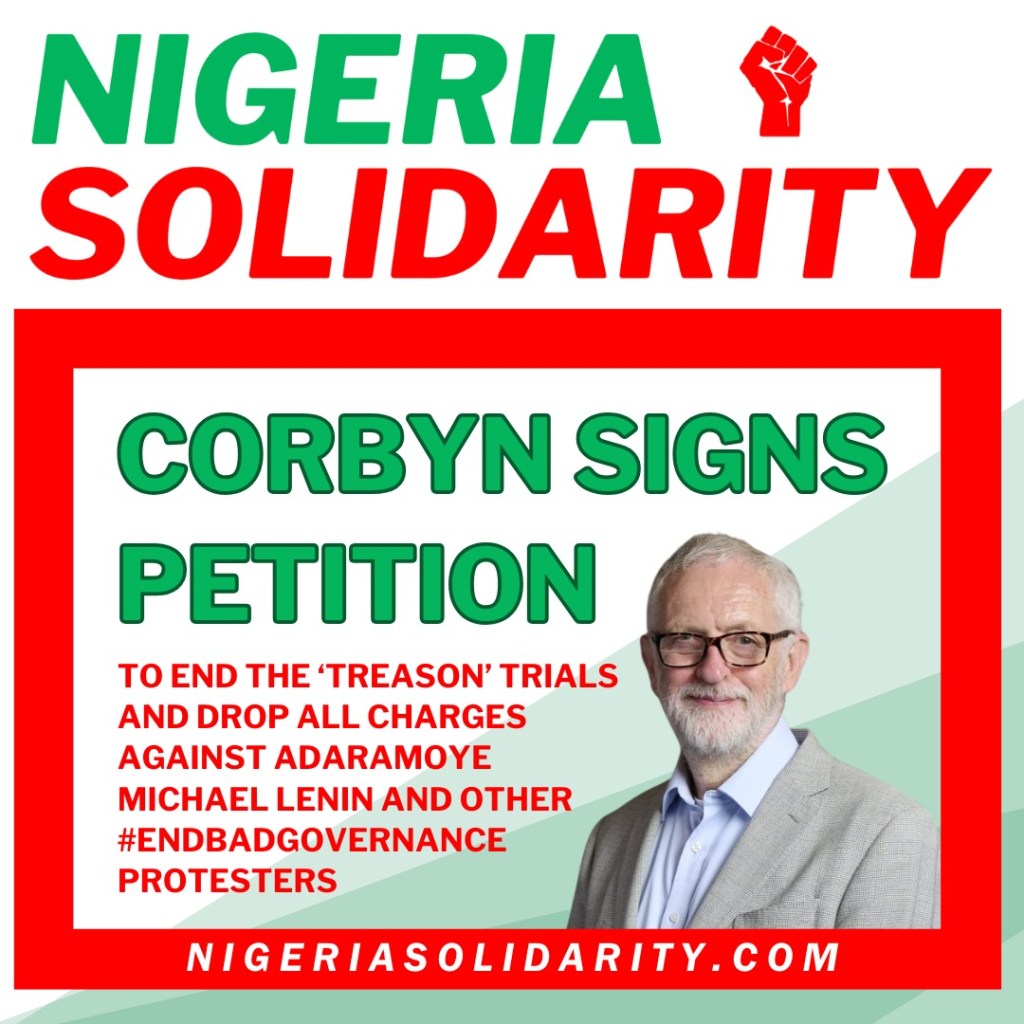
We are surprised that the same reprieve has not been extended to Adaramoye Michael Lenin and other protesters still on trial despite the fact that the charges against all of them are broadly the same. We believe that the further entertainment of this matter will not only lead to a wastage of the precious time of the court but also help sustain a national and global embarrassment to the image of Nigeria. Solidarity protests have been held at Nigerian embassies or diplomatic offices in a number of countries in Europe and the US at every court day since last September. We are also aware that Jeremy Corbyn, former leader of British Labour Party, recently signed a petition to the Nigerian High Commissioner in the UK, calling for the withdrawal of charges against #Endbadgovenance protesters and an end to attacks on democratic rights of Nigerians by the government This is why we would like to urge the Attorney General of the Federation to use his power to ensure that the time of the court is not further wasted on what is clearly a frivolous and malicious prosecution.

Francis Nwapa

National Secretary

Youth Rights Campaign

Email: youth_rights@yahoo.com

Tinubu Tax Reforms Will Compound The Economic Crisis

The CDWR holds public symposium and calls on workers to organize actions to reject the bills and fight for a political alternative.

By Davy Fidel

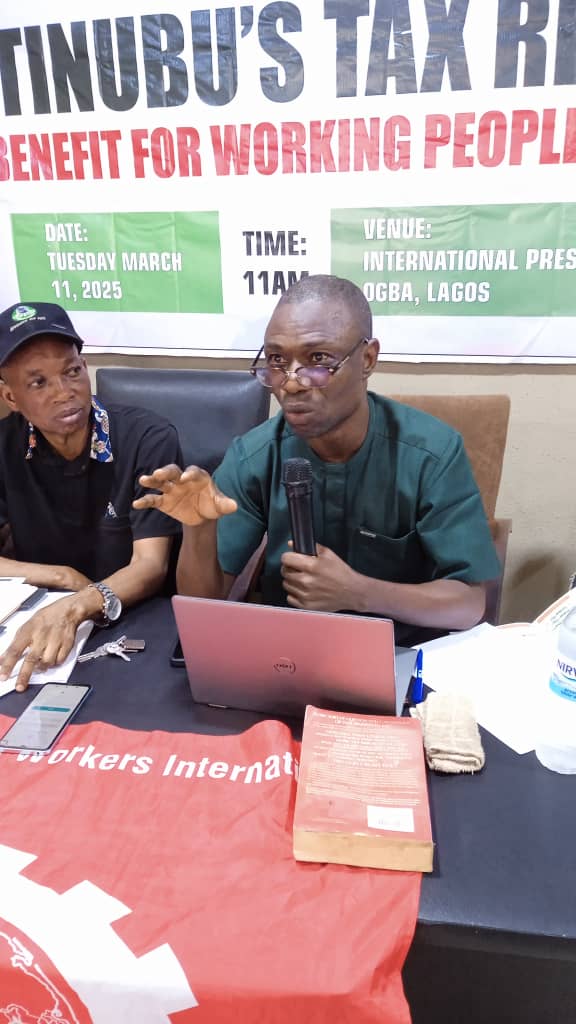
On Tuesday 11 March 2025, the Campaign for Democratic and Workers Rights (CDWR) organized a public symposium to discuss the implications of President Bola Tinubu’s Tax Reform Bills currently before the National Assembly for working people and the poor. The theme of the symposium is: “Tinubu Tax Reform: Any Benefit for Working People and the Poor?’’

One of the objectives of the symposium is to use the gathering to call on workers in the trade unions to mount pressure on their leadership to mobilize for actions against the bills and other anti-poor neo-liberal capitalist policies.

In attendance, both physically and virtually, were about 60 people from trade unions and civil society organisations. These include the representatives of the Lagos councils of the two labour centres, Nigeria Labour Congress and the Trade Union Congress. Some individual industrial unions – affiliated to either the NLC or TUC – were also represented. They included Academic Staff Union of Universities (ASUU), Association of Senior Staff of Banks, Insurance and Financial Institutions Employees (ASBIFIE), Cab Operators Union, Lagos State Council of Amalgamated Union of Public Corporation, Civil Service Technical and Recreational Services Employees (AUPCTRE), Lagos State Council of National Association of Nigeria Nurses and Midwives (NANNM), Precision Electrical and Related Equipment Senior Staff Association (PERESSA), National Union of Food Beverage and Tobacco Employees (NUFBTE) and Lagos State Welders Association. The left and civil society organisations in attendance were Democratic Socialist Movement (DSM), Centre for Popular Education (CEPED), MEKUNU-KOYA, Joint Action Front (JAF), ACTIVISTA, Movement for African Emancipation (MAE) and Socialist Vanguard Tendency (SVT).

The speakers at the event were Lanre Akinola, a chartered account and NEC member of the Democratic Socialist Movement (DSM) and Dr Dele Ashiru, National Convenor, ASUU Committee on Students and Civil Society Organizations. Other speakers were Abiodun Aladetan, Lagos State Secretary, Trade Union Congress and Bisi Idowu Vice Chair, Nigeria Labour Congress (NLC) Lagos State Council.

Rufus Olusesan, National President of PERESSA and also the national chair of the CDWR, moderated the symposium. He introduced the theme and highlighted the ills behind the tax reforms and why workers must begin to unite themselves via the trade unions so they can challenge the bills. In his introduction, he said. “’this public symposium is to discuss the bill and how workers can engage it before it becomes a law.”

He added that the cost of living and inflation has devalued the new minimum wage of N70, 000 the Tinubu presidency is boasting they have enacted to ease the suffering of workers. Stressing the consequences of the tax reform bills, Rufus also emphasized that workers must not trust the government or fall behind the propaganda that workers under the N70, 000 will be exempted. He said, “It will be a self-harm for any worker to agree with such propaganda.”

He further stressed the fact that this government of Tinubu does not serve the interest of workers and the poor working people. Rather, the ruling elites defending the neo-liberal policies of the IMF and World Bank only understand how they will continue to use them to stiffen the life of the oppressed Nigerians.

Lanre Akinola, a tax expert, who was the lead speaker elaborated the issues around the tax reform bills, and why the reform doesn’t serve the interest of the working people and why workers must protest against it.

He used the example of the privatization of the power sector, which has proved to be a monumental failure and fraud contrary to what the government made the ordinary people to believe before it was carried out, as a reminder to the working people not fall for lies and deceit of the government that the tax reform will benefit ordinary workers and the poor. He explained that why it is true that in the bill anybody earning N800,000 and below is exempt, they will be made to pay much more through VAT and other anti-poor policies like increment in school fees in addition to the existing impacts of the devaluation of the Naira and removal of the fuel subsidy. Besides, he further explained, a few workers in the public sector would really benefit from tax relief put in the bills.

Lanre Akinola, a chartered accountant and member of DSM NEC

In the course of his speech, Lanre also explained the damage that tax reform will do to public education, health, social services, and all other aspects of life for the working people in Nigeria. For instance, he said that if the bills become laws school fees in public tertiary universities will be so astronomical and children from working class homes won’t be able to access public university education. This is because one of the plans of the bill is to scrap Tertiary Education Trust Fund (TETFund) which largely accounts for the provision of infrastructures and facilities in the tertiary institutions. In his words, “If TETFund began to withdraw their funds from public tertiary institutions, it will mean school fees may triple and many students will drop out of the university because their parents won’t be able to pay their school fees.”

He further explained how the government of Tinubu plans to use VAT to further compound the suffering of working people and the poor, struggling to cope with the current social economic hardship. He warned that workers shouldn’t dance behind any section of the capitalist ruling elite, playing up ethnic and regional card over the sharing formula. Rather, they should unite in their strength to oppose the bill and fight for improved living conditions.

On his part, Abiodun Aladetan – the State Secretary, TUC Lagos –shared his personal ordeal of the electricity tariff and the exorbitant bill of N35 million, the estate he resides received. He was firm in his words when he said “the privatization of the power sector has failed and it is not working.” On the tax reform bill, he stated that the position of the TUC includes the rejection of the planned hike in VAT and demand for an increase in the tax minimum threshold from N800,000 to N2.5m. He added that state leadership is making an effort to educate workers about the danger inherent in the tax bills. However, just like the NLC, whose representative also spoke, there is no a program of action by the TUC to defeat the bills or enforce their own demands.

Dr. Dele Ashiru started by going on historical lane, stating that the current attacks of the Tinubu government on workers and the poor is a continuation of the Structural Adjustment Programme (SAP) that was introduced by the military dictator Ibrahim Babangida in mid-1980’s in line with the dictates of the  IMF and World Bank. On TETFund, he recalled how the struggle of ASUU over university funding led to the establishment of the Fund. According to him, while ASUU has some questions over the democratic management and accountability of the Fund, it is vehemently opposed to its scrapping. He added that the tax reform in general is a summary of the government shifting the burden over to the working people and relieving the super-rich from paying fair taxes. The state, he said, has failed to uphold its responsibility and it is hiding under a fraudulent saying that the state doesn’t have business in business. To him, “free quality education is possible and it is the state that must fund it.’’

A new pamphlet produced by the CDWR and titled “Tinubu’s Tax Reform Will Compound Economic Crises”’, was presented at the symposium by Chinedu Bosah, Publicity Secretary of the CDWR and a leading member of the DSM. He spoke briefly on the bill and why workers in the trade unions must not be quiet. He argued that the tax reform bill can be used to steer a national campaign and mobilise for mass actions against the government and its anti-poor policies. However, the trade unions must be willing to be active in the campaign and drive the campaign in conjunction with civil society groups.

Click Cover image to read pamphlet PDF

Copies of the pamphlet were shared to the unions and civil society organisations in attendance, and an open appeal was made to the unions for donation towards producing more copies for wider circulation among workers and other subsequent material necessary for a struggle against the tax reform. The pamphlet will be updated with new details after the bills are passed into law.

The contributors to the discussion from the audience were all critical of the lack of seriousness on the part of the national leadership of both the NLC and TUC. Therefore, they urged the labour leaders to begin mass mobilization of the working people and work with the civil society to build national actions in order to defeat the anti-poor provisions of the bills before they become laws.

A worker making a contribution at the symposium

It was also stressed that the struggle against the tax reform must be linked with the struggle against the entire anti-poor capitalist policies and the need for a mass working political alternative with a socialist program.

The pamphlet states in part, ‘”Under capitalism, the rule of engagement is to subject the working class and the poor masses into exploitative slavery. It is the organization of the working classes such as the trade unions that should resist exploitation and organize to eventually defeat capitalism.”

Solidarity songs were chanted to bring the symposium that lasted for over 4 hours to an end. But before then the DSM comrades had sold 26 copies of Socialist Democracy – the paper of the organization.

CDWR email: campaignworkers@yahoo.co.uk

#EndBadGovernance Protesters – Local and International Protests Call for End of Sham Trial and Dropping of Charges

Protest actions were held again in Nigeria and the UK on Wednesday January 29 in continuation of local and international campaigns over the unjust detention and trial of #EndBadGovernance protesters as well as increasing attacks on democratic rights in Nigeria. The campaign had earlier forced the government, through the courts, to release many detainees, including minors, though in most cases on bail with stringent conditions while some others had the charges against them dropped.

It should be recalled that mass protests were held across Nigeria last year over mass hunger and economic hardship compounded by the anti-poor neo-liberal capitalist policies of the Bola Tinubu government. Fearful that these #EndBadGovernance protests could get a big response the government decided to firmly clamp down on the protests. Tinubu is very aware that less than 9 million voted for him in 2019 in a country of over 230 million.

Protesting outside the Abuja courthouse on January 29

However, it is not yet a total freedom for all those who have been released. For instance, Adaramoye Michael Lenin and 10 others, who regained freedom on bail after languishing for about two months in the police and prison custodies, are facing trumped-up charges including treason, which carries a death penalty, at the Federal High Court in Abuja. Hence, the chief demand of the campaign at present is for the government to end the sham trial by withdrawing the trumped-up charges. On Tuesday, January 28, the Kano State government dropped similar charges against protesters being tried at the State High Court. The campaigners demand that the Federal Government, which prosecutes Michael Lenin and 10 others, and other state governments also follow suit .

Kano state is governed by an opposition party, the NNPP. It is possible that it withdrew the charges in order to appear to the working masses as being different from the APC/Tinubu led Federal Government. For the Tinubu government, the trial is being used as a deterrent to any form of serious opposition against its anti-poor neo-liberal policies. Therefore, the campaign has to be sustained and strident to force the government to withdraw the charges.

Therefore, it was good and correct that the campaigners went ahead with the solidarity protest despite having been aware a day earlier that the trial would not be held again on January 29 as scheduled. That was the second time the commencement of the trial had been postponed – the first being November 8. The new date is March 26.

January 29 ‘Treason’ trial protest outside the Nigerian High Commission in London

In Abuja, civil society activists held a protest at the Federal High Court Abuja where Michael and others stand trial. Members of Socialist Party (CWI England and Wales) and Nigeria Solidarity UK were at the Nigerian High Commission in London for a solidarity protest. Also, many branches of the Socialist Party in England and Wales also held different solidarity actions as did comrades of the Socialist Party Scotland (CWI Scotland). Earlier, on Monday January 27, Youth Rights Campaign – a campaign group of the Democratic Socialist Movement (DSM) – held a press conference and protest in Lagos.

In all the protest actions, in addition to calling for dropping of charges against activists on trial and release of all those still in detention, the demands also include an end to increasing attack on democratic rights and the reversal of the anti-poor policies which have caused a serious fall in the living standards for the vast majority.