Victory At Last! #EndBadGovernance Activists ‘Treason’ Trial Cancelled

Pressure forces Nigerian Government to anabdon sham trial of Adaramoye Michael Lenin and 10 other #EndBadGovernance protestors charged with treason and terrorism

Today, December 10, 2025, Justice Emeka Nwite of the Federal High Court Abuja struck out the treason and terrorism charges against Adaramoye Michael Lenin and 10 others. In his ruling, Justice Emeka lamented that the prosecuting counsel had shown a lack of diligence and seriousness in the case they initiated against the protesters. Subsequently, Michael Lenin and his co-defendants, who were detained and put on trial over the August 2024 nationwide #EndBadGovenance protest against mass hunger, economic hardship and anti-poor policies of Bola Tinubu government, were acquitted. Other activists are Daniel Akande, Mosiu Sadiq   Adeyemi Abiodun Abayomi, Angel Love Innocent, Bashir Bello, Nuradeen Khamis, Buhari Lawal, Opaluwa Eleojo Simeon, Suleiman Yakubu. Abdulsalam Zubairu.

Since the arraignment of the 11 #Endbadgovernance protesters on September 2, 2024, after unlawfully spending many weeks in police cells and prison, the Nigerian government had wasted public resources to sustain charges of treason and terrorism against them without being able to prosecute their own case. Rather, the police prosecutors repeatedly employed different delayed tactics and sought adjournment after adjournment. At least all of them were eventually given bail and freed from prison.

We recall that on June 25, 2025, Justice Emeka warned the prosecuting counsel to desist from further delaying the trial and expressly stated that the case would be struck out if the police further attempted to postpone the trial, following the resilient agitations of the legal representatives of the activists. The judge was actually compelled to strike out this case due to the relentless campaign of our comrades and supporters locally and internationally. Repeatedly public protests were held around the world while trade unions and civil rights organisations demanded this trial stopped. It was the same pressure that forced the government and police to abandon the trial as the police prosector was absent in court today. Left to the government and police, they were prepared to perpetually tie the treason trial around the neck of the #EndBadGovernance activists in order to serve as deterrent to further mass protests against its anti-poor policies and attacks on democratic rights.

It is fitting and instructive that the news of the court victory came when activists were again on the streets of Lagos, Ibadan and elsewhere in Nigeria to use the occasion of the December 10 World Human Rights Day to highlight and put on the front burner the demand for an immediate end to the sham trial of 11 #Endbadgovernance activists and an end to other instances of attacks on democratic rights in Nigeria. The Youth Rights Campaign (YRC) expresses a profound appreciation to all the lawyers who rendered free legal service and comrades, supporters and activists locally and internationally for their sustained pressure and unflinching support throughout the periods of arrest, detention, and trial.

We consider this a victory, not just for the 11 #Endbadgovernance activists, but also for all Nigerians desirous of a better society. This is an example that we can fight and defeat a tyrannical government like the Tinubu government. Nigerian working people and youths must continue to fight consistently against bad governance and pro-capitalist policies of the government.

The Youth Rights Campaign (YRC) demands a public apology from the Nigerian government to all acquitted #Endbadgovernance activists, return of the properties and unfreezing of the bank accounts. We also demand adequate compensation for the 11 activists and all victims of abuse during and after the #Endbadgovernance protest. We also demand the immediate freedom of all the jailed #Endbadgovernance protesters sentenced to seven years imprisonment in Borno and withdrawal of charges against anybody still on trial over the August 2024 #Endbadgovernance protest. We maintain that protest against anti-poor policies and bad governance is a democratic right and must not be criminalized.

Francis Nwapa

National Secretary

YRC email: youth_rights@yahoo.com

Drop Sham Charges and End Treason Trial of #EndBadGovernance Activists

Treason Trial of Michael Lenin and 10 Others Comes Up Again on October 9 at FHC Abuja

Again, on Thursday October 9, Adaramoye Michael Lenin and 10 other activists are expected to appear, for the fifth time, before the Federal High Court in Abuja for a treason trial as a result of their participation in the nationwide #EndBadGovernance protests in August 2024. We of the Youth Rights Campaign (YRC) believe that what the activists are facing is a sham trial as protest against anti-poor policies is not tantamount to treason.

We therefore demand that the government withdraws the trumped-up charges preferred against these #EndBadGovernance protesters who are currently on bail with stringent conditions after having been incarcerated for at least two months both in the police custody and prisons. The other activists are Daniel Akande, Mosiu Sodeeq, Adeyemi Abiodun Abayomi, Suleiman Yakubu, Opaluwa Eleojo Simeon, Angel Love Innocent (female), Buhari Lawal, Bashir Bello Nuradeen Khamis and Abdulsalam Zubairu.

We strongly believe that the government cannot prove the charges against the activists as they are ridiculous and frivolous. For instance, the police in their charge sheet state that the activists committed treason, which carries a death penalty, because they carried a placard with a message: “End Bad Government”.

We believe that the inability to prove the charges is the reason the government has continued to employ delayed tactics in this case, something in which the trial judge, Justice Emeka Nwite, appears to be complicit. Since last November when the trial was first scheduled, it was only on the last adjourned date of June 25 that Judge himself was available in court, having been absent three times previously. Even at the said last sitting, there was no trial as a lawyer who appeared as the new police prosecutor, in order to further waste time, requested more time to study the case. We challenge Justice Nwite to fulfill the promise he made in the court on June 25 that he would strike out the case if the prosecutor further delays the trial.

It is not out of place to conclude that as part of its wider policy of criminalizing dissent, the government is determined to tie the treason trial around the neck of the #EndBadGovernance activists in order to serve as deterrent to another mass protest against its anti-poor policies.

Therefore, we call on civil society organisations, human rights groups, socialist and left groups, trade unions, activists and individuals of good conscience, in Nigeria and internationally, to support the demand for dropping of charges against the eleven #EndBadGovernance activists on trial in Abuja, and others across the country on similar sham trials, in order to totally regain their freedom. There should be also demands for an end to attacks on democratic rights and reversal of all anti-poor policies, which were the reason for the nationwide protest in the first place.

We commend individuals and groups, locally and internationally, who have been part of the struggle and solidarity for freedom for #EndBadGovernance activists since August 2024. We call for continued solidarity actions until there is total victory.

Francis Nwapa

National Secretary,

Youth Rights Campaign (YRC)

Email: youth_rights@yahoo.com

One Year of the ‘Treason Trial’

(IMAGE: Adaramoye Michael Lenin)

Today, September 2, 2025, marks exactly a year since the Tinubu government arraigned Adaramoye Michael Lenin and nine other #EndBadGovernance protesters over their role in the #EndBadGovernance protest, which took place between August 1 and 10, 2024. Michael Lenin – National Coordinator of YRC, Mosiu Sodiq, Angel Love Innocent, Buhari Lawal, Adeyemi Abayomi, Eleojo Opaluwa, Nurudeen Khamis, Bashir Bello, Suleiman Yakubu and Abdulsalam Zubairu were detained for weeks at a notorious detention centre of the Police in FCT Abuja, popularly known as Abattoir.

False and outrageous charges were levelled against them, including treason, terrorism, and mutiny, among others. Consequently, they were remanded in prison and were only granted bail on stringent conditions after 9 days. In fact, most of them had to spend about a month in jail because they couldn’t meet the bail conditions easily. Importantly, they were re-arraigned on September 17, 2024, with another detained protester, Daniel Akande, added to the defendants.

The Youth Rights Campaign (YRC) uses this opportunity to demand the immediate dropping of these nefarious and false charges against #EndBadGovernance protesters. After a year, the prosecutors have not provided any evidence to support their claims of treason, terrorism, etc. In fact, the case has suffered several adjournments. This delay tactic is to ensure the charges of treason and terrorism continue to be hung around the necks of these activists; this is inline with the antics of the Tinubu government to criminalize dissent. We also call on civil society organisations, youth groups, trade unions, individual activists and people of good conscience to support the demand for the immediate withdrawal of the sham charges and carry out different solidarity actions like issuing public statements, sending protest messages and organizing peaceful demo on or before October 9 which is the next date for the adjourned treason trial at the Federal High Court Abuja.

We also seize this opportunity to reiterate our call for the release of seven #EndBadGovernance protesters who were recently convicted in Borno state and sentenced to prison. We strongly believe that no Nigerian should be sent to prison or punished for exercising their fundamental rights to protest. The judiciary must not become the bride of despotic politicians or offer itself to be used to undermine basic human rights.

The Youth Rights Campaign (YRC) also calls for freedom for all who are still in detention or on trial in connection with #EndBadGovernance protest.

The Tinubu government has continued to act true to its draconian nature; the attacks on the fundamental rights of Nigerians are still ongoing. In fact, cases of police brutality have become a daily occurrence. Alongside this calamitous situation is the continuation of the neo-liberal and anti-masses polices. None of the demands made by Nigerians during the #EndBadGovernance protest has been met by the government; it ignored them all. To respond to this, we need a united mass platform of resistance, uniting all oppressed layers of society, particularly the working masses. We urge the labour leadership to wake up to its responsibility and lend its weight to the building of mass resistance against repression and anti-poor policies under the Tinubu government.

  • We demand the immediate and unconditional dropping of all charges on Michael Lenin, and other #EndBadGovernance protesters
  • We reiterate our call for the immediate release of seven unjustly convicted #EndBadGovernance protesters in Borno and all protesters still in prison
  • We demand justice for all Nigerians killed and injured during the #EndBadGovernance protest
  • Working people and youth must unite against attacks on democratic and anti-poor policies of the Tinubu failed government

Youth Rights Campaign (YRC), Nigeria

ABBEY TROTSKY VS NIGERIA POLICE: Court Hearing Adjourned Again till November 27

Appreciation for Solidarity and Appeal for Continued Support

The long running criminal case of Abbey Trotsky vs. Nigeria Police has been adjourned till November 27, 2025, following the absence of the presiding magistrate at Magistrate Court 6, Iyaganku Division, Ibadan. The magistrate was away on official duty, although the police prosecutor had earlier noted that their third witness was not yet ready for cross-examination.

Abbey Trotsky, Oyo State Coordinator of the Campaign for Democratic and Workers’ Rights (CDWR) and Acting National Chairperson of the Socialist Party of Nigeria (SPN), faces charges brought by Sumal Food Limited through the Nigeria Police. These charges arise from his support in October 2018 for casual workers at Sumal Food Limited who were demanding better wages and improved working conditions. These show that the criminal allegations and charges levelled, in 2019, against Abbey Trotsky are trumped up and politically motivated.

Abbey Trotsky (second from left) with supporters outside a Magistrate Court in Ibadan on September 12

The hearing drew strong solidarity from activists and trade unionists, including Prof. Ademola Aremu, Oyo State Coordinator of the Joint Action Front and former National Treasurer of the Academic Staff Union of Universities and Comrade Andrew Emelieze, former Trade Union Congress, TUC Chairman, Oyo State Chapter. Their presence highlights the broad support from left activists and pro-masses organisations for Abbey Trotsky in this protracted legal struggle.

The CDWR extends heartfelt appreciation to all media organizations, both those on the ground and those providing virtual coverage, for their steadfast attention to this case, which stands as a symbol of the fight for labour rights and social justice in Nigeria. At the same time, we are appealing for continued national and  international political and financial support to sustain the legal defense and public campaign. Since the case began in 2019, it has spotlighted not only the challenges faced by pro-labour activists but also the fact that the police are tools in the hand of bosses for suppression of workers’ rights and interests. Again, the unwavering solidarity shown to Abbey Trotsky underscores the significance of this struggle against casualization and exploitative labour practices. We reiterate our consistent call on the leadership of Nigeria Labour Congress (NLC) to take seriously the struggle against casualization

We of the CDWR remain hopeful for a just conclusion of this matter as we remain undaunted in our campaign against casualization and other forms of indecent labour practices including the defense of workers’ rights across Nigeria.

Yusuf Salaudeen

For the CDWR Oyo State chapter

E-mail: campaignworkers@yahoo.co.uk

June 12: Protesters Call for Sustained Resistance against Tinubu’s Anti-Poor Policies and Attacks on Democratic Rights

On June 12, protests were held in a few states across the country as a continuation of an expression by the working masses and youth of their rejection of the anti-poor capitalist policies of the Tinubu government and its descent into civilian dictatorship with attacks on democratic rights. In other words, the conduct and action of the Tinubu government, which celebrates June 12 as “Democracy Day”, runs contrary to the ideals of the day which was a watershed in a protracted struggle of Nigerians to end military dictatorship and enthrone a democratic rule with the hope of better living standards. However, it is apposite to state that on the basis of bourgeois democracy and economic programme, especially in a neo-colonial country, there was no guarantee that June 12 election won by MKO Abiola would have heralded better living standards for the vast majority.

Protesting in Lagos

Members of the Democratic Socialist Movement (DSM) joined socialists and civil society activists to organise protests in Lagos, Oyo and Osun states. The turnout was small compared to the recently past nationwide protests, for instance the last October 1 protest, not talk of the #EndBadGovernance protests in August 2024. For instance, Lagos which recorded the biggest outing had just about 300 protesters.

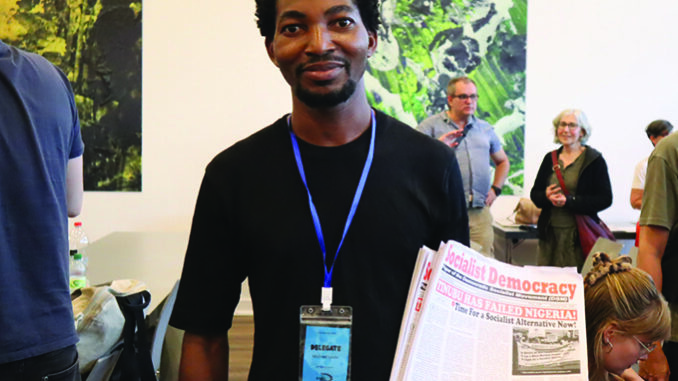
However, the protests, which were energetic and inspiring, enjoyed massive support from passers-by, bystanders, motorists and residents of areas the protesters passed. This underscores the fact the vast majority of working people and youth remain vehemently opposed to the Tinubu government and its policies. Indeed, this is reflected, in Lagos for instance, in an impressive sale of Socialist Democracy, the paper of the DSM. with a frontpage headline: “Tinubu Has Failed Nigeria”, with the majority of the copies sold being bought by those on the sidelines of the protest. It actually shows that the assertion of the headline resonates with most Nigerians on whose living standards and livelihood the capitalist policies have had devastating effects. For instance, a journalist who bought the paper in Ibadan used the image of the front page with the headline to illustrate the feeling of many Nigerians on the failure of the government in an open letter he did to Tinubu on social media.

H. T. Soweto speaking in Lagos

The relatively small turnout at June 12 protest is most likely because the past actions were not able to force the Tinubu government to reverse the ruinous policies coupled with its sustained attacks of democratic rights attacking as a deterrent to any resistance and opposition to the policies. Therefore, many chose not to expend their time and energy on the protest but rather faced their daily struggle for survival. The leadership of the labour movement deserves the most blame for this situation. If they had not refused to put forward organised labour as a platform for a serious mass resistance against the anti-poor policies, some real concessions could have been won if not an outright reversal. We therefore reiterate the call on workers and trade union activists to mount a sustained pressure on the labour leadership to organise a serious struggle, for instance, a 24-general strike and mass protest as the first step, against the anti-poor policies of the Tinubu government. Despite a legitimate lack of trust in the leadership of labour by the working people and youth because of the past betrayal a serious mass mobilisation can draw massive supports for a general strike and bring several thousands on the street.

Protesting in Ibadan

Therefore, the resolve of the working people, youth and activists who have sustained the resistance in the face of a depressing mood, the indolence of labour leadership and the intimidation of the Tinubu government is commendable. They have helped put on the front burner the feeling and position of the vast majority who are firmly against the anti-poor policies despite the propaganda of the government.

The protest despite its size also served as a bold statement and warning to the Tinubu government it is not a walkover for it. The government had to organise a counter protest in Lagos and deploy the police to attempt to intimidate and disorient the anti-government protesters. Besides, given a deep-seated mass anger against the government, it is not ruled out that a spark could provoke a tumultuous revolt before the next general elections.

The support of the Nigeria Bar Association (NBA) Ikeja branch for the protest in Lagos is commendable. Before the protest they sent a letter to the state Commissioner of Police warning him against any plan to violate the rights of the protesters and did a fantastic report, which was widely circulated, after the protest highlighting the unprofessional conducts of the police including their expected bias towards the pro-Tinubu protesters.

Many copies of Socialist Democracy were sold.

Altogether, tens of thousands copies of separate leaflets issued by the #EndBadGovernace Lagos State, Joint Action Front (JAF) and DSM were widely circulated before and during the protest. The leaflets and also various placards in these protests generally call for the reversal of the anti-poor policies, end to attacks on democratic rights, dropping of trumped-up charges against Michael Lenin and others still on sham trial in connection with the #EndBadGovernace nationwide protest of August 2024, a serious tackling of the deepening insecurity etc. The materials of both the DSM and JAF in addition argue for why the working people and youth in addition to sustaining resistance against the anti-poor policies must also support building of a mass working people party on a socialist programme.

TINUBU HAS FAILED NIGERIA

Time For a Socialist Alternative Now!

On May 29, 2025, President Bola Ahmed Tinubu would clock two years in office. In that space of time, his neo-liberal capitalist economic reforms have led to a destruction of livelihoods and the economy on a scale previously unimagined.

By H.T Soweto, lead article ‘Socialist Democracy’, May-June 2025 edition 

For example, the pump price of petrol which Tinubu met at N197 per litre when he came to power on May 29, 2023 now hovers around N800 to N900 per litre – a marginal drop from its peak of around N1,100 per litre last year. The naira has also sharply depreciated from N463/$1 in early May 2023 to nearly N1600/$1 as at April 2025. Within the same period, headline inflation rate rose from 23% in April 2023 to 35% in December 2024 – the highest in the last three decades! On the same score, food prices are more than 80% higher than when the election was held.

These are the consequences of the IMF and World Bank neoliberal capitalist reforms, otherwise known as the “Renewed Hope Agenda”, that President Tinubu chose to implement as soon as he took power. In implementing these policies, Tinubu and the ruling All Progressive Congress (APC) had promised that they would lead to prosperity for Nigeria. Two years after, none of the promises has materialized. Instead, the neo-liberal reforms have resulted in greater inequality, hunger and deepening poverty.

TWO YEARS OF BLUNDER

Even from a capitalist point of view, Tinubu’s decision on May 29, 2023 to withdraw fuel subsidy and then shortly after, to devaluate the naira, is nothing short of a blunder. It is no hidden secret that crude oil is the elixir of Nigeria’s neocolonial economy. While only contributing between 5 to 10 percent to the overall GDP, it accounts for nothing less than 80% of national revenue and 90 percent of foreign exchange earnings. Everything – from economic production, to transportation, lighting of homes and offices as well as cooking – runs on affordable petrol and other derivatives from crude oil.

In the same vein, Nigeria’s currency devaluation is unarguably one of the largest adjustments anywhere in the world. Within a few weeks, the naira shed about 70% of its value. Only the Ethiopian currency, birr, has seen a bigger move recently. By tinkering with the oil subsidy which had kept fuel within affordable limits while also devaluing the naira, Tinubu opened the door to a catastrophe. Clearly Tinubu and the clique around him gambled that these moves would have a better outcome than the result of Buhari’s mixture of austerity and attempts to support different economic sectors.

However, the result of Tinubu’s neo-liberal policies is that high inflation, forex volatility and surging production costs have become the defining feature of the economy over the past two years. This has impacted Nigeria’s manufacturing sector causing a contraction. As data shows, the sector’s contribution to the GDP decreased from 8.42% in the third quarter of 2023 to 8.21% in the same period last year while the sector’s growth rate also slowed on the back of weakened consumer demand, escalating production costs, and declining purchasing power. This has forced several multinational firms to relocate out of the country even as others have closed shop. Indeed, an 87.5% surge of unsold inventory running into N2.14 trillion was recorded for the year 2024 compared to 2023, a report of the Manufacturer Association of Nigeria (MAN) has shown.

One of the consequences of naira devaluation is the improvement in Nigeria’s balance of payments as well as increase in national revenue. As the value of the currency has fallen, Nigeria’s dollar earnings from oil and gas sales, customs and excise duties, VAT and corporate income tax have all increased exponentially. This, together with the removal of oil subsidies, has caused a narrowing of Nigeria’s fiscal deficit from 6.4% of GDP in early 2023 to 4.4% in early 2024. Also, for the first time in many years, Nigeria’s has recorded a trade surplus while Nigeria’s foreign reserves now exceed $40 billion.

But these gains have been made at the cost of near destruction of the economy. As we write, more than half of Nigeria’s total Gross Domestic Product (GDP) has been wiped off over the past two years that Tinubu came to power. Despite the picture of growth that its naira-denominated variant portrays, the country’s GDP in dollar terms has actually declined from $363.82 billion in 2023 to $188.27 billion in 2025.

They are also unstainable gains. At some point, currency devaluation can result in an opposite effect one of which is encouraging capital flight in the form of companies and individuals finding ways to repatriate their wealth out of the country. Moreso, whatever macroeconomic stability has been achieved through the reforms now face headwinds from a global capitalist economy in turmoil.

WORLD ECONOMY IN TURMOIL

Since President Donald Trump came into power at the Oval Office in the US, his administration has become the great accelerator of all the contradictions of the global capitalist order. The developing trade war, provoked by Trump’s imposition of tariffs in April, has led to ripples in stock market and crash in crude oil price on the world market.

From its peak in January, Brent crude, the international oil benchmark, has dropped 19.31%. This poses grave consequence for commodity exporters like Nigeria. This explains why the International Monetary Fund (IMF) has now cut its growth forecast from Nigeria from 3.2% to 3%. This is expected to slow further to 2.7% next year. Although marginal, this speaks to the fragility of Nigeria’s economy two years into the reform.

Nigeria’s 2024 budget forecast oil at $75 a barrel but crude oil has slumped to around $66. One of the immediate impacts for Nigeria would be a decline in revenue. This will have the effect of reversing any gain in fiscal balance that the government reforms have reportedly achieved. The IMF estimates the country’s current account balance will shrink from 9.1% of GDP last year to 6.9 per cent in 2025.

This is on top of the warning by the US investment bank JP Morgan that Nigeria could slide into a current account deficit if the decline in oil prices is sustained. Lower oil price also means lower foreign exchange earnings. This will cause further instability in the foreign exchange market with the possibility of the dollar exchanging for as high as N2, 000 in a short period of time. Presently, the British pound has crossed the mark as it already exchanges for over N2, 000 to a naira.

Reduced revenue may also make it more difficult for Nigeria to service its existing debt, further straining its finances. As of March 2024, Nigeria’s total public debt stood at N121.67 trillion ($91.46 billion) – an increase of N24.33 trillion from December 2023. Debt servicing consumed 47%, N13.12 trillion, of the Federal Government’s total expenditure in the first nine months of 2024, highlighting the significant burden on the nation’s finances. Any significant shortfall in revenue therefore poses an even greater catastrophe than what has been experienced in the last two years.

GROWING INSECURITY

A feature of Tinubu’s two years in power is the regime’s cluelessness in the face of the growing insecurity across the country. Nigeria’s countryside, from the East to the North, is practically in a state of war.

In the North east of the country, Boko Haram and the Islamic State of West African Province (ISWAP) have increased their attacks. Their two-pronged assaults on military bases in Borno state and alongside Nigeria’s border with Cameroon between 24 and 25 March 2025 introduces a new frightening dimension to the conflict. Eye witness accounts suggest that the Islamist militants utilized armed drones in the attack. This could mark a new stage in a conflict that has lasted over ten years leading to about 30, 000 deaths while displacing about two million people.

In the Middle belt and towards the South, the violent actions of bandits and kidnappers have also continued. In the South East of the country, the agitation by the Indigenous People of Biafra (IPOB) as well as Eastern Security Network (ESN) has not abated. Curiously, the regime continues to hold the separatist leader, Nnamdi Kanu, in prison even when his continuous detention is a crucial element provoking the violence. Neither has the perennial violent conflict between herders and farmers stopped. This year has already witnessed a certain deterioration in the historical conflict over land and water resources. Alongside this is a high risk of a religious war breaking out due to how the violence is stoking religious sentiment.

Tension is high in most communities while security forces have been accused of failing to protect villagers from attacks. At least, 13,346 people were killed and over 9,207 abducted within the first one year of Tinubu’s administration. Sadly, the major conflict-zones are concentrated in states which account for most of Nigeria’s food production. Consequently, the rampaging insecurity is part of the major factors driving food inflation in the country.

WE CANNOT CONTINUE LIKE THIS

Despite all the movement in inflation, income growth for the rest of the working population remains weak reflecting limited gain in living standards over the past two years. From a GDP per capital of $2, 200 in 2022, Nigeria’s GDP per capita declined to $835 in 2025 highlighting how much toll Tinubu’s reforms have taken on the masses. In the same vein, wages have stayed abysmally low relative to the rate of inflation. Indeed, when the dollar value is considered, the current N70, 000 minimum wage negotiated by trade unions last year has the same purchasing power as Nigeria’s wage of N125 four decades ago!

Aside shelter, food and transportation are crucial elements of a workers’ wage. Yet these are sectors showing some of the highest inflation increase in price. While food have seen an 80% increase in prices in recent times, transport fares for interstate travel rose by 403.5%, airfares rose by 280.7% on the average while water transport fares also rose by 148.8 percent rise over the past two years. As a report by Business Day Newspaper shows, three out of ten workers allocate over 20% of their salary to transport costs while over 50% of Nigerians spend almost all of their income on food alone.

The result is an ever-expanding arc of misery for the working masses and the poor. Indeed, some families now go without food as they cannot afford to have three square meals in 24 hours. Yet, a few billionaires have seen their wealth increase exponentially within the past two years showing the pro-rich character of Tinubu’s reforms. According to Forbes, billionaire Aliko Dangote has seen his wealth nearly double from $13.4 billion last year to $23.9 billion in January 2025, which ranks the Nigerian entrepreneur as the wealthiest person in Africa and 86th in the world. Three other billionaires, Mike Adenuga, Abdulsamad Rabiu, and Femi Otedola, have seen their wealth increase in the same manner.

Their combined wealth, derived from inheritance, monopoly power, and cronyism, is valued at $23.7 billion. This is an amount so vast that, according to Oxfam, it could easily cover the whole of Lagos city in 500-naira notes. In fact, Aliko Dangote alone could spend N1 million daily for 42 years without depleting his fortune! Meanwhile, over 133 million Nigerians, around 70% of the population, are struggling with hunger while thousands are dying because they cannot afford hospital bills.

Faced with an economic policy that is not working  increasingly Tinubu’s answer to both insecurity and opposition is repression. But this will not work because Tinubu’s regime is both a defendant and servant of the capitalist system whose failures are at the root cause of the issues. With the majority facing falling living standards while the multi-millionaire Tinubu regularly takes ‘working’ holidays in Europe resentment can only grow. Tinubu knows that under nine million actually voted for him and now he is fearful of the tens of millions of Nigerians that don’t support him, hence repression of protesters and suppression of music critical of him.

WHAT NEEDS TO BE DONE

165 years ago, Karl Marx noted that “there is something rotten in the very the core of a society that increases its wealth without diminishing its misery”. The extreme wealth inequality which are the result of Tinubu’s neoliberal economic reforms of the past two years is not only an indictment of Tinubu himself, it is also an indication that capitalism is broken and need to be replaced.

This raises the question as to whether there is no other way of running Nigeria other than the corruption, cronyism, exploitation and repression that have been the defining feature of governance over the past 6 decades. There is actually another way. That is through the Socialist reconstruction of Nigeria. This would require the working class coming to power and nationalizing the commanding heights of Nigeria’s economy like the oil and gas firms, big monopoly companies and banks and their placement under workers democratic control and management. Such a step backed by a socialist plan of development can begin to ensure that Nigeria’s economy is run to meet the needs of the people instead of the greed of a few billionaires.

It is also under such an arrangement that Nigeria’s insecurity can be tackled through the democratic resolution of the National Question which is a crucial factor behind the cacophonic agitations across the country.

To achieve this however means that the working people, youth, trade unions and pro-masses organisations have to step up the struggle against Tinubu’s anti-poor policies, for a living minimum wage, against repression while starting the crucial work of building a political vehicle, a mass workers party on a socialist program, to begin to fight to wrest political power from the hands of the capitalist gangsters holding the country to ransom and begin the socialist reconstruction of Nigeria.

MINIMUM WAGE – N70,000 Not Enough

  • Workers and Trade Unions Should Fight for Full Implementation AND Begin Mass Struggle for a Living Wage

 The Nigerian working class continues to suffer under the crushing weight of high cost of living and economic crisis. The current national minimum wage of N70,000 is, in reality, a huge joke. Yet the new minimum wage, which in less than a year has been eroded by inflation and rising cost of living, has not even been implemented by many states and private sector employers. For instance, according to Punch newspaper, at least 20 states have not begun the implementation for primary school teachers and local government employees (Punch, April 7).

By Moshood Osunfurewa

All this means that there is an urgent need for workers and trade union activists to mount pressure on the leadership of the Nigeria Labour Congress (NLC) and Trade Union Congress (TUC) to lead a serious struggle for the implementation of the current minimum wage. As we said in a previous article, the struggle must be centrally coordinated by the national leadership even when taking place at state level. This means that workers must not be left to whims and caprices of the state labour leaderships, many of whom are bribed lapdogs of their state governors. And where state labour leaders organize a serious struggle, there must be solidarity actions initiated by the national leadership so that they are not isolated.

Besides, even in some of the states where the N70,000 minimum wage has been purportedly implemented workers’ take home has been seriously dented by heavy taxation imposed by the state governments, for instance in Kwara state. Unfortunately, instead of the Kwara state labour leadership leading a serious struggle against the anti-worker taxation they chose to grovel before the governor who granted workers three months of tax relief, which had ended in December 2024. Indeed, the labour leadership ought to have factored in the taxes when negotiating the consequential adjustment of the salary structure following the enactment of the new national minimum wage.

It should be noted that the situation in Kwara is not an isolated case. Many state labour leaders did a bad job at the expense of workers in the negotiation. This is why workers and trade union activists must fight for an arrangement which forbids labour leaders signing agreement on pays and condition with the government or private employer without having first tabled it for a democratic decision at a workers’ congress.

This experience of Kwara state and other states as well as the fact the anti-poor capitalist policies such as the fuel subsidy removal, devaluation of the naira and electricity tariff increase which labour leaders refused to resist with mass struggle have rendered the minimum wage, which from its start last July was grossly inadequate, further worthless, should not be lost on workers, trade union activists and genuine labour leaders.

Unfortunately, it does not appear that any lesson has been learned. For instance, there are tax reform bills currently before the National Assembly, which are essentially anti-worker and anti-poor. Yet, beyond mere lamentation on its adverse implications, the national labour leadership have not mobilized workers to resist the reform. Workers and trade union activists should begin agitation at workplaces and through organs of unions for the NLC and TUC to take the issue of the tax reform seriously and mobilise for a mass struggle to defeat it.

What the national labour leadership were able to achieve at the last minimum wage negotiation, albeit marginal, is the reduction of the minimum wage review cycle from 5 years to 3 years. Though, we had argued that the minimum wage should be constantly reviewed in line with the rate of inflation, this is relatively better than the old minimum wage law. This means that a new national minimum wage is due in 2027. But the process towards it must start immediately.

Therefore, workers and trade union activists should begin agitation to put pressure on the labour leaders to immediately begin mass mobilization for a new national minimum wage, in addition to enforcing the full implementation of the current one. The minimum wage should be made an important issue in the campaigns for 2027 general elections. Given the rising cost of living and inflationary rate, we are of the opinion that workers must not accept anything less than N250,000 as the new national minimum wage, and as against the current agreement, it should be automatically increased in line with inflation.

We call on workers not to accept the argument from the government it is not possible for the economy to support such a decent wage. Workers and trade unions should demand a reduction of jumbo salaries and allowances of political office holders and other top government functionaries including placing them on average wage of skilled civil servants. The wasteful and fraudulent contracts system through which roads and other projects are carried out at outrageous and inflated costs should be scrapped and replaced with democratically managed and controlled public works. This if linked with the nationalisation of the key sectors of the economy and their planning under democratic workers control and management can ensure that resources are generated to pay living wage and carry out other basic functions.

Obviously to achieve a living wage will require a serious mass struggle. We have to recognise that today Labour is not in the same position that it was twenty or more years ago. The experience of years of Labour issuing bold words which are accompanied by either no action, or token actions rapidly halted, have undermined Labour’s standing as a force that will can for working people and the poor. In this situation workers should call on the labour leaders who are not prepared for the struggle to voluntarily resign or be replaced. At the same time Labour needs to be revived from the grassroots upwards and, when necessary, initiatives need to be taken from below to start action and inspire others to join in.

This mass struggle, we have advocated, should also demand reversal of all anti-poor capitalist policies including but not restricted to reduction of fuel and electricity prices to an affordable rate. It also includes an end to casualization and contract staffing, building of new public refineries, reversal of privatization of the power sector and deregulation of oil and gas sector. However, such renationalized power sector, public refineries and oil and gas sector must be placed under democratic control of working people.

Also importantly, given the experience of the 2023 general election where all the major presidential candidates advocated broadly the same anti-poor neo-liberal policies which largely account for the current devastation of the living standards and none was committed to paying a living wage, the struggle for the demands highlighted should be linked with the need for building a democratically run, and non-monetised, mass working people party on a socialist programme. Experience, both in Nigeria and internationally has shown that on the basis of profit-first, iniquitous capitalist system, it is not possible to achieve a living wage for workers and the provision of other basic needs of life on a permanent basis. Hence, the need for a government which on the basis of democratic socialist planning make them achievable. Workers and trade unions have to fight for this.

No to Imposition of State of Emergency in Rivers State:

Working People Should Reject Tinubu Government’s Growing Descent to Civilian Dictatorship

No Illusion in Any Capitalist Politician. For a Mass Working People Political Alternative

Statement of the Democratic Socialist Movement (DSM)

The imposition of the emergency rule in Rivers State is the latest of the anti-democratic actions from the stable of President Bola Tinubu. Recently, he forced 36 legislators of the 40-member Lagos House of Assembly who had democratically removed their speaker to reverse their decision because they did not have his blessing. Though, now in Abuja as the President, he still calls the shots in Lagos, where is a former governor, like the lord of the manor. Besides, his government regularly attacks democratic rights of working people and youth including rights to freedom of expression and protest.

Clearly throwing his official heavyweight behind Nyesom Wike, who is in political standoff with his estranged political godson Governor Sim Fubara over the control of the soul and resources of the oil-rich state, President Tinubu on March 18 suspended the Rivers governor and the State House of Assembly and appointed former Chief of Naval Staff Vice Admiral Ibok-Ete Ibas (rtd.) as the sole administrator for the next six months. In other words, with the earlier dissolution of the local government councils on the order of the Supreme Court which nullified the process of their emergence, there is no semblance of democratic institution in Rivers State. So, what obtains at present is reminiscent of a military rule.

According to Tinubu in his national broadcast over the state of emergency, the administrator will not make new laws but he is free to formulate regulations as may be found necessary. However, such regulations are subject to the consideration and approval of the Federal Executive Council (FEC) where Wike sits as a Minister. Though, the House of Representatives passed a resolution that the National Assembly should take over the role of the Rivers State assembly, it does not really reduce the direct influence of the FEC on the Sole Administrator. In other words, Wike, the leader of a party to the conflict that purportedly prompted the suspension of the governor, will be involved in running the state as a FEC member. Though, the conflict is officially between the state governor and the vast majority members of the state House of Assembly, it is Wike who is pulling the strings of the latter.

To be clear, it should be stressed that Fubara, who as Rivers State Accountant General was shielded by Wike from arrest by the EFCC over corruption allegations, is not a saint in this conflict. Fubara callously demolished the Rivers House of Assembly complex and prevented the majority of members from sitting apparently to avert a possible impeachment. He derecognized 27 members in a 31-person assembly and was undemocratically dealing with four members with whom he was governing the state including on laws, budget and appointments.

It was a judgement by the Supreme Court delivered on February 28 which tilted the scales against the governor as it favoured the 27 legislators. The judgement reversed all the undemocratic actions of the governor. Therefore, after the initial grandstanding, Fubara began to make move to play ball most likely on the terms of the assembly members. For instance, following the order of the Supreme Court, he dissolved the local government councils and made a move to re-present the 2025 budget proposal which had been earlier approved by his 4-member assembly.

Therefore, there was no immediate basis for the impeachment process that the state assembly initiated against him shortly before the declaration of state of emergency. Rather, it was the resolve of Wike and his sidekick assembly members to get even with the governor that prompted the plan to remove him.

Indeed, it was not impossible that the notice of impeachment itself was a calculated tactic from the Wike camp with the support of Tinubu to create a basis for the imposition of the emergency rule. It was not likely for the impeachment plan to succeed, if it had gone ahead, as the Chief Judge of the state, who is required by the constitution to set up a panel to investigate the allegations leveled against the governor, is an ally of the governor.

No doubt, Governor Fubara fell for the trap. At a gathering shortly before his suspension, he had made a speech which only thinly veiled his endorsement of a threat of attacks on oil and gas pipelines made by some Rivers state youth should he be impeached. However, it is not yet clear whether any of the pipeline explosions that took place in the state recently had any direct link to the threat or the political crisis in the state. Indeed, according to media reports, findings have shown that some reported explosions at oil facilities were false. “For instance, the viral video on social media alleging that suspected militants bombed two Nigerian National Petroleum Company Limited (NNPCL) flow stations at Cawthorne Channel in the State was false. It was confirmed that the explosion was an old clip from a February 19, 2025, explosion at Cawthorne Channel 1 in Iloamatoru, Bonny, which claimed three lives” (Guardian March 23, 2025).

Nonetheless, Tinubu cited “disturbing incidents of vandalism of pipelines by some militants without the governor taking any action to curtail them” as one of the grounds for the imposition of the state of emergency. However, typical of bourgeois politicians, this is a demonstration of blatant hypocrisy by Tinubu who as an opposition figure in 2013 had in condemnation of the state of emergency on Borno, Adamawa and Yobe by the then President Goodluck Jonathan, argued that state governors had no real power to guarantee security. Then in his words Tinubu said: “No Governor of a state in Nigeria is indeed the Chief Security Officer. Putting the blame on the Governors, who have been effectively emasculated, for the abysmal performance of the government at the centre which controls all these security agencies, smacks of ignorance and mischief.”

Truly, it was political mischief, not the “actual breakdown of public order and public safety” or the danger of it, that prompted the removal of the state governor. While it is for Wike to regain his fierce hold on the state and its resources, to Tinubu, it is a cold move and desperation to have an ally or a weakened opposition figure in control of the state ahead of the 2027 presidential election. It should be recalled that the local and international observers expressly believed that 2023 presidential election in Rivers State was brazenly rigged in favour of Tinubu by Wike as the then state governor. And, Wike, who was rewarded by Tinubu as the Minister of the Federal Capital Territory (FCT) Abuja and who has his ‘yes men’ in the national leadership of the PDP, has in further return of favour helped cripple that party such that it is unable play any real or seeming opposition to Tinubu.

Tinubu, with the lowest ever share of votes to become a President in the history of Nigeria, has even had his limited electoral support originally based on ethnic and religious affiliation eroded because of his unabashed, anti-poor neo-liberal capitalist policies which have had devasting effects on the vast majority. Therefore, it is not out of place to conclude that to him his re-election bid will be a do or die affair. In other words, he is prepared to do anything no matter how undemocratic and unlawful in order to be officially declared the winner of the 2027 presidential election.

So whichever way one looks at it, Tinubu’s declaration of State of Emergency in Rivers State stands as an assault on civil rule. The process of the implementation of the declaration itself which saw both chambers of the National Assembly approve the undemocratic policy without first ascertaining quorum and amidst allegations of bribery is an additional indication of the absurdity of the all exercise. Therefore, the working class, the youth, unions, social movements and all credible forces must condemn and reject this development. To this extent, we welcome a joint statement of the Nigeria Labour Congress (NLC) and the Trade Union Congress of Nigeria (TUC) in which they “unequivocally condemn Mr. President’s hasty and unconstitutional declaration of a state of emergency in Rivers State.”

However, we disagree with them that “beyond the political and legal implications, this unjustified state of emergency will … lead to job losses, wage cuts, and economic hardship for thousands of workers in both the formal and informal sectors”. This is because the assertion gives an impression that job losses, wage cuts, and economic hardship were not a feature or reality in Rivers State, nay Nigeria, already long before Tinubu’s declaration of emergency rule. The fact is that as a result of the neo-liberal capitalist policies of Tinubu, which are supported by all the governors including Fubara and which the leaderships of the NLC and TUC have failed to seriously oppose or fight against, the economic hardship and poor economic indices, which preexisted the Tinubu government, have been greatly worsened. Indeed, the national minimum wage of N70,000 won by the NLC and TUC in 2024 is actually a wage cut if compared with N30,000 minimum wage won in 2019 as a result of inflation triggered by the anti-poor capitalist policies of Tinubu.

Nonetheless, we call on the NLC and TUC not to limit their opposition to the state of emergency in Rivers to a mere statement. They, together civil society organizations, should also organize a nationwide mass protest and other legitimate actions in order to make a bold statement against an action of Tinubu they describe as “not only unlawful but a direct assault on democracy”. But it should not also be lost on the organized labour that Fubara in the course of the conflict was also a culprit of “direct assault on democracy”.

Good enough, the Rivers State councils of both the NLC and TUC have already indicated that “the organised labour may be compelled to take strategic union actions which might disrupt national economic activities if our demands are not met within a reasonable timeframe.” However, this must not be a mere hot air.

Moreover, the protest we have proposed and whatever action Labour may plan must not be limited to rejecting the emergency rule in Rivers alone but generally include all the attacks on democratic rights of working people and youth and the descent to civilian dictatorship, something which has become a feature of the Tinubu government. In order to ride roughshod over the working people with its anti-poor policies, stifling of democratic rights including freedom of expression and criminalization of protest have become a state policy of the Tinubu government. For instance, over 2000 persons including minors were incarcerated for about two months in police detention and prison in connection with #EndBadGovernance nationwide protest against mass hunger and economic hardship in August last year. Not done, Tinubu government has preferred trumped-up charges including treason which carries death penalty, before Federal High Court Abuja, against 11 activists including Adaramoye Michael Lenin, National Coordinator of YRC and a member of DSM because, according to the police court paper, they carried placards with inscription: “End Bad Government”! Many young people and bloggers have also been detained or made to face sham trial on undemocratic, fraudulent cyber laws.

The latest action of President Tinubu represents a concrete escalation in the situation in Nigeria. More and more, Tinubu regime is acting like a dictatorship in a bid to push through its anti-poor economic reforms and maintain political control while in the process undermining civil rule in the eyes of the masses especially the youth. This may have implication in the near future. At the moment, the truth will not be lost on many – that an ‘elected’ president enlisted elements of the military (even though retired) in an attempt to take control of an opposition-rule state ahead of the next general elections.

Going forward, while working people must resist attacks on democratic rights and any action or measure that tends to further erode even the limited democratic space which has been won, they must not have illusion in any capitalist politician or line behind any section of the capitalist ruling elite. The experiences since the return to the civilian rule in 1999, for instance, have shown that all capitalist politicians at all levels are prepared to unleash “direct assault on democracy” to advance their self-serving interests, and they all carry out anti-poor policies as a logical consequence of their inequitable, profit-first and greed-enabling capitalist system. Therefore, in order for the working people and youth to really enjoin what is popularly termed in Nigeria as “dividends of democracy” there is need, in addition to consistent struggle against anti-poor capitalist policies, for a mass working party that could wrest power from the thieving capitalist ruling elite and begin to organize the country on the democratic basis of socialist planning.

Peluola Adewale

Organising Secretary

For Democratic Socialist Movement

CDWR Demands End to Exploitation of Lagos State Sweepers

The Campaign for Democratic and Workers’ Rights (CDWR) condemns the response from the Lagos State Waste Management Authority (LAWMA) concerning the inhumane treatment and exploitation of Lagos State sweepers. Rather than addressing the grave issues raised, LAWMA’s response was a futile attempt to save face, revealing its complicity in the unjust and exploitative system it oversees in connivance with contractors under its supervision. We strongly condemn the illegal and exploitative practices employed by LAWMA and its contractors in engaging sweepers under degrading and substandard working conditions.

A recent viral video brought to public attention the harrowing realities faced by the Lagos State sweepers. In the video, a female sweeper courageously spoke out about the pain, suffering, and indignities inflicted upon her and thousands of sweeper colleagues by the Lagos State government and its contractors. Among the shocking revelations were the imposition of slave wages that fall far below the legally stipulated minimum wage of N80,000, the requirement for sweepers to purchase brooms and other necessary work tools using their meager salaries, and the absence of safety gear, thereby exposing sweepers to dangerous working conditions while sweeping highways, roads, and bridges.

This distressing situation is yet another revelation to the failures of privatization, which serves as a mechanism for government cronies and corrupt officials to siphon public funds while subjecting hardworking individuals to inhumane treatment. In line with the fraudulent contract system, privileged individuals within the corridors of power are given contract to employ sweepers and in turn the contract pay sweepers a fraction of the salary they are entitled to, hereby allow the contractors to earn fat profit. In this case, Lagos State Government through LAWMA may pay the contractors N80,000 or more for each sweeper but sweepers gets about N40,000 or less. So, the contractors pockets about N40,000 for each sweepers monthly and a whopping N480 million annually if the sweepers are 10,000.

The Lagos State government, under Governor Babajide Sanwo-Olu and the ruling All Progressives Congress (APC), continues to demonstrate blatant disregard for workers’ rights. Instead of ensuring decent wages and working conditions for workers who keep the state clean, the government promotes exploitative policies that benefit profiteers and corrupt politicians at their expense. However, the plight of Lagos State sweepers is not an isolated case but a reflection of the broader injustice experienced by many workers across both public and private sectors not only in Lagos but also nationally.

CDWR hereby calls on the Lagos State government to immediately ensure that all sweepers receive the minimum wage as stipulated by law and be subjected to the upgraded minimum wage structure. Sweepers should be given permanent and regularized employment under LAWMA, as many have worked for over six years as contract staff. All parasitic contractor arrangements under LAWMA must be discontinued, and contractors responsible for violating workers’ rights must be held accountable and prosecuted for gross misconduct.

We also call the two labour centres – the Nigeria Labour Congress (NLC) and Trade Union Congress (TUC) – to take decisive actions to support the struggle and demands of the sweepers. These should include solidarity protests and the demand for an immediate recognition of the rights of the sweepers to form or join a union or association of their choice to enable them to collectively bargain for better wages and working conditions.

The CDWR stands firmly in support of the Lagos State sweepers and all workers fighting for decent pays and conditions, dignity of labour, fair treatment, and economic justice. We urge the Lagos State government to end its complicity in labour exploitation and take immediate steps to rectify these injustices.

Rufus Olusesan

National Chairperson

Chinedu Bosah

National Publicity Secretary

CDWR email: campaignworkers@yahoo.co.uk

President Tinubu’s Claim of Decline in food prices amidst mass hunger and sufferings is Fallacious

Only economy and agricultural system run on the basis of needs and not profits through massive state investments can guarantee food security

FFRC calls on farmers, market men /women and all suffering Nigerians to organize and demand an end to hunger and cost of living crises

The attention of the Food and Farmers’ Rights Campaign (FFRC) has been drawn to a remark by the President Bola Tinubu, that his anti-poor neo-liberal capitalist economic policies have reduced the soaring prices of food items and brought reliefs to the fasting Muslim community and indeed Nigerians at large.

According to media reports, President Tinubu made this remark in a message to the Muslim community on Friday, February 28th, 2025. He was quoted as saying “the once-soaring prices of essential food items are now trending downward, providing much-needed relief to our fasting population and Nigerians”!

He went further by saying that “as the wet season approaches, we remain steadfast in boosting agricultural productivity. We are determined to enhance food production and ensure food security for all Nigerians”.

The FFRC wishes to note that contrary to President Tinubu’s claims, his pro-rich anti-poor economic policies as prescribed by the IMF/World bank, rather than brings reliefs, have brought untold and unprecedented hardships and sufferings of unimaginable proportions on the mass of poor suffering and fasting Muslim population. The policies have also made the vast majority of poor and working masses starved, and go hungry without food. Therefore, the claim of relief by President Tinubu is an insult to the sensitivity of poor suffering Nigerians, and  also at the best a figment of his imagination!

Admittedly, FFRC notes that there are indeed marginal reductions in some prices of essential food items like rice, beans and garri. However these decreases fizzle into thin air and amount to nothingness when juxtaposed with the soaring cost of other food items like pepper, tomatoes, yam, egg, beef, dairy products, etc which have currently skyrocketed. In addition, the increments in fees across tertiary institutions nationwide; the current prohibitive house rents across cities; high cost of drugs and treatments in both public and private health institutions among others have made nonsense of President Tinubu’s touted ‘downward trends’ of soaring food prices.

So what the APC-led Tinubu’s government is doing is dishing out propaganda and gaslighting the general public in vain attempts at  understating the deleterious and iniquitous effects of it fuel subsidy removal and the devaluation of the Naira  for the suffering majority. The FFRC wishes to put on record that while the poor and working masses continue to gasp for breath under the choking anti-poor policies of the Tinubu government, the ruling elites, both the public office holders and big business bosses continue to corruptly fish in the socioeconomic and political murky waters.

The Tinubu government also claimed that “as the wet season approaches, we remain steadfast in boosting agricultural productivity. We are determined to enhance food production and ensure food security for all Nigerians”! The FFRC wishes to state without mincing words, that this would amount to sheer rhetoric and grandstanding, unless a determined struggle is waged to demand that government at all levels invest public funds in social services like affordable housing, electricity , education, healthcare system, agricultural productivity etc, placing same under democratic management and control, so as to meet the needs of the suffering majority and not profit for a few rich. With this it is possible to begin to guarantee food security and reduce cost of living crises. Any thing short of these would remain a mirage.

The FFRC also urges farmers’ market men and women, workers and the poor majority who are barely surviving, to come together and organize to demand that  government reverse fuel subsidy removal, devaluation of the Naira, increase in electricity tariff, and other anti-poor policies which largely account for the current suffering and hardship.

Eko John Nicholas

National Coordinator

Food and Farmers’ Rights Campaign (FFRC)