CDWR Supports NLC-Led Protest Rally Against 50% Hike in Telecommunication Tariff

CDWR SUPPORTS NLC-LED PROTEST RALLY AGAINST 50% HIKE IN TELECOMMUNICATION TARIFF

CDWR CALLS ON NLC TO LEAD A DETERMINED MASS RESISTANCE AGAINST ALL ANTI-POOR POLICIES

Campaign for Democratic and Workers’ Rights (CDWR) condemns the recent approval of 50% tariff hike in telecommunication services by the Nigerian Communications Commissions (NCC). This outrageous hike in telecoms tariff will worsen the already high cost of living and increase cost of doing business; thereby compounding the economic hardship faced by workers and the masses. It is for this reason, the CDWR is in support of the protest rally called by the Nigeria Labour Congress (NLC) and scheduled to take place on Tuesday January 4, 2025.

The telecom operators and NCC have argued that operating cost has increased and has made hike in telecom tariff inevitable. Telecom operators cited hike in the prices of petroleum products, devaluation of the Naira, hike in electricity tariff etc. Unfortunately, the telecom big companies like other big business capitalist supported President Tinubu anti-poor policies or did not oppose it but now use it as the justification for the increase in tariff, Considering the damaging effect of these neo-liberal policies, the reasonable thing to do is for the Tinubu-led government to reverse these policies. Rather than doing this the government and its private sector big business collaborators are hiking tariff, passing on the burden to the working masses and inflicting more hardship on the working masses.

It is not shocking that government granted every request of big businesses and IMF/World Bank to hike tariffs and prices for the purpose of guaranteeing huge profits for the privileged few at the expenses of the masses. This is so because it is a government run by big businesses, imperialism and their agents. Tinubu government’s consolidation on the neoliberal programme through hike in prices of petroleum products and electricity as well as the devaluation of Naira made the cost of living, production and services spiralling out of control, drove inflation to a new high and imposed an unprecedented hardship in the land.

The reason the Tinubu-led government and the private sector are emboldened to impose more hardship on the masses is because of the failure of the leadership of the trade unions to put up a resistance fight against anti-poor policies. The NLC leadership has failed to sustain resistance struggle in the past despite voicing an opposition to some of the anti-poor policies. Indeed, together with the TUC leadership, they practically did little or nothing to resist the petrol subsidy removal and the devaluation of the naira. It is not possible for the NLC to successfully fight the telecom 50% tariff hike without waging a determined struggle to reverse electricity tariff hike, hike in prices of petroleum products, increase in school fees etc. Hence, the NLC leadership should dedicate itself to leading a sustained resistance struggle against all anti-poor policies.

It is not enough to embark on a-day rallies across the country and go to sleep. For instance, the NLC and TUC leadership were opposed to electricity tariff hike but failed to resist it. The leadership of the NLC and TUC must change from its present lacklustre attitude towards struggle that defends the interest of the working people and wage a relentless and sustained mass struggle against all anti-poor neo-liberal policies including well-mobilised general strikes and mass protest. NLC and TUC leadership, workers and the poor masses should demand the nationalisation of the commanding heights of the economy and placed under democratic control and management of workers and community people. This is in order to make possible a judicious and efficient use of the collective wealth of the country for the interest of the vast majority.

SIGNED:

Comrade Chinedu Bosah
National Publicity Secretary

From “Renewed Hope” to “Renewed Hopelessness”

By H.T. Soweto

Tinubu’s Capitalist Policies Have Failed! Time for a Socialist Alternative! At a recent high-level meeting in Nigeria’s capital Abuja in May this year, the British High Commissioner to Nigeria, Dr. Richard Montgomery, said the following “I’d like to use this opportunity to express the whole lot of support of my government to the Renewed Hope Agenda of His Excellency, the President of the Federal Republic of Nigeria, Bola Tinubu. We commend his agenda for its focus on priorities and delivery. We acknowledge that you have done a lot to put in place transparency and accountability”. (Press from the Office of the Vice President Kashim Shettima 17 May 2024). Similarly, in November, the Managing Director of the International Monetary Fund, Kristalina Georgieva, also commended “Nigeria’s decisive actions to reform the economy, accelerate growth and generate jobs for its vibrant population. The IMF strongly supports Nigeria on this journey.” (Punch Newspaper, 22 November 2024).

No doubt, millions of Nigerians must be wondering whether these high priests of global capitalism are talking about the same country as the one they live in when they commend Tinubu’s policies in such glowing tones. This is because over the past 16 months, their experience of the Tinubu government and its economic reforms is nothing but hopelessness and mass misery.

AN ECONOMIC CATASTROPHE

While on the campaign trail in 2023, Tinubu promised to reform the economy in order to usher in growth and development in all areas of life including agriculture, infrastructure, public education and health care and job provision. His vision for Nigeria was captured in a blueprint titled “Renewed Hope Agenda” wherein he pledged to build “a Nigeria, especially for our youth, where sufficient jobs with decent wages create a better life” and one where “no parent is compelled to send a child to bed hungry, worried whether tomorrow shall bring food. He also pledged to “make basic healthcare, education, and housing accessible and affordable for all”, and to “generate, transmit and distribute sufficient, affordable electricity to give our people the requisite power to enlighten their lives, their homes, and their very dreams”.

Nearly two years after, none of these promises has been kept. Instead, Tinubu has succeeded in plunging the entire country into a new depth of hopelessness and mass misery. Between May 29, 2023 and now, the price of petrol has increased by about 355 percent thereby detonating an inflationary rise in the prices of all commodities. The result is what has been variously described as the worst cost of living crisis in a generation! Even though GDP growth has recently improved to 3.46% year-on-year in Q3 2024, the cost of living crisis persists. In fact, so bad is the situation that millions are starving as food prices have rocketed by 61 percent over the past one year. According to a United Nations estimate, nothing less than 35 million more Nigerians are at risk of acute starvation next year.

As we have previously observed, the key to the unfolding economic catastrophe in Nigeria was the decision of President Tinubu to implement IMF/World Bank prescribed economic reforms principally the abolition of petrol subsidy and the devaluation of the country’s currency. These reforms were carried out despite their attendant negative consequences for the productive capacity of the country and in expectation of promises of more usurious loans despite Nigeria’s already huge debt profile. In the last one year alone, nothing less than 11 multinational companies have exited Nigeria. The list includes Pfizer, PZ Cussons, GSK, Jumia Food, Bolt Food, Procter & Gamble etc. Gone with them are hundreds of jobs in an economy where unemployment is at over 40 percent – although the National Bureau of Statistics (NBS) claims a lower figure of 5.3 percent by saying that anyone who works an hour a week is not unemployed! The exit of the companies is reportedly due to the impact of the increase in fuel price and devaluation of the Naira on business operations. Of course, this cannot entirely be true since manufacturers already passed the impact of the policies to consumers by raising prices yet it gives an insight into the confounding economic catastrophe the neoliberal reforms have created.

Aside operational costs, consumer spending capacity has declined seriously due to inflation and effect of naira devaluation on income. The recent increase in the national minimum wage from N30, 000 to N70, 000, though yet to be paid across the country, is unable to raise the living standards of the working class. This is because in real terms, the N70, 000 minimum wage is lower in value than the worth of N30, 000 minimum wage five years ago when it was first signed into law. Five years ago when the old minimum wage was signed into law, N30, 000 was worth $83 in dollar terms, now the new minimum wage of N70, 000 is worth only $42 in dollar terms today. In addition, over 80 percent of Nigeria’s workforce are employed in the unregulated informal sector where the minimum wage law is hardly respected by employers of labour. This therefore means that even if the new wage is fully paid by both the Federal and state governments, only a fraction of the workforce would benefit leaving millions of Nigerians still struggling to survive on poor wages amidst a rampaging inflation.

LABOUR’S WEAK RESPONSE

Sadly, the leadership of the labour movement have been unable to mount the kind of resistance that the situation demands. Instead, the leadership of the Nigeria Labour Congress (NLC) and the Trade Union Congress (TUC) have spent the last one and a half years pussyfooting despite the neoliberal offensive against the working class. Occasionally, the labour leadership issues bold and radical press statements to respond to the economic policies of the government but except for appeals and threats, the labour movement is yet to put forward a clear strategy to resist the onslaught. Indeed, given the obvious contradiction between radical words and inaction, the labour leaderships seem to have drawn the conclusion that it is often better to be silent.

But even the fewer press statements have become weak politically in terms of the position of the movement on the key neoliberal economic policies of government. So for instance, labour has abandoned the movement’s traditional rejection of fuel subsidy removal and call for reversal of any increase in the pump price of fuel. This ideological and political retreat has had a demoralizing effect on the union members and also the general movement as a whole, by adding to the mood of despair or feeling that nothing can be done.

But if the labour bureaucrats thought ‘bending the knee’ to the capitalist status quo would be of any benefit, the law of unintended consequences appears to have answered their illusion. At the end, the labour bureaucrats only succeeded in weakening their own position and this was made manifest in the way and manner the regime, emboldened by the retreat, recently harassed and arrested the NLC president, Joe Ajaero. The development was a lesson in how class collaborationism or social dialogue is a danger to the labour movement. Unfortunately, the leadership of the NLC and TUC do not seem to have fully learnt the lesson leaving the rank and file activists and Socialists the responsibility of campaigning to rebuild the trade union movement and refashion it as a platform of struggle.

FOR A 48 HOUR GENERAL STRIKE AND MASS PROTEST

Part of that would include campaigning within the labour movement for a properly prepared 48-hour general and mass protest to breathe new life into the mass resistance against the regimes’ anti-poor policies. Since early this year, a mass movement against the neo-liberal economic policies slowly built – its peak being the #Endbadgovernance protest that erupted for ten days in August. Instead of answers to the demands, protesters were met with water cannons and live bullets by the police and the army. Also, hundreds of protesters were arrested and detained including member of the Democratic Socialist Movement (DSM) and National Coordinator of the Youth Rights Campaign (YRC), Adaramoye Michael Lenin, who, with others, is now standing trial for treason at the moment.

A new report by Amnesty International titled ‘Bloody August: Nigerian Government’s Violent Crackdown on #Endbadgovernance protests’ has exposed the chilling details of the bloody repression which left at least 24 dead. “In almost all cases the victims were shot by the police – firing live ammunition at close range, often at the head or torso, suggesting that they were shooting to kill. Of the survivors interviewed, two protesters suffered gunshot injuries after being shot in the arm and leg by the police. Several survivors were suffocated by indiscriminate use of tear gas” Amnesty International said in the report.

Due to the scale of the repression which continues even up till now, plus labour’s inaction, the mass movement has slowly stalled but the overall situation continues to worsen. In fact, between August and now, petrol prices have gone up at least twice! Now as the year ends, many working families are bracing for one of the worst yuletide in Nigeria’s recent history due to the economic situation. In this situation, a call for a two-day general strike and mass protest especially starting early next year can help to reignite the mass movement against the regime’s neo-liberal offensive.

However, even in the likely situation that the NLC and TUC leadership fail to call a general strike, there is still a need for activists to begin to discuss how to prepare for the next stage of the struggle. For us in the DSM, we think that there should be plan for new nationwide actions starting from February next year. To make this achievable, groups and organizations like the Joint Action Front (JAF), Take it Back (TIB), #Endbadgovernance Movement, ASCAB, TPAPM, Nigeria Patriotic Front Movement (NPFM) and others need to discuss to draw up a common plan and programme.

A POLITICAL ALTERNATIVE NOW AND FOR 2027

Linked to this is the need for a mass workers and poor people’s political alternative to fight for political power. One indubitable fact that has been proven in the last 24 years of civil rule is that unless the working class seize political power and begin to run Nigeria on Socialist basis, none of the fundamental economic and political contradictions facing Nigeria can be resolved.

Unfortunately, the Labour Party (LP) registered by the trade unions has not been able to play the role of such a political alternative despite the significant support its Presidential candidate, Peter Obi, got in the 2023 general elections. Peter Obi is a supporter of capitalism – the same social and economic system and programme that is behind the crisis plaguing Nigeria. Many of Obi’s young supporters are genuinely interested in changing Nigeria. Many of them are playing important roles in the struggle to challenge the anti-poor policies of the Tinubu regime and especially the #Endbadgovernance movement which erupted in August. As the class struggle unfolds, the best of them are bound to draw the conclusion soon that what is needed is a democratically run political party and candidates that stand fully opposed to capitalism.

But what would in particular hasten this radicalization in mass consciousness is the building of a mass party of the working class, youth and poor masses on Socialist programme. Such a party involved in the day-to-day struggle of the working masses and radical youth, unlike the Labour Party (LP) which distances itself, will demonstrate very clearly what kind of party is needed to liberate Nigeria. While we of the DSM are committed to the ongoing effort at seeing the possibility of reclaiming and repositioning the LP as a genuine working people party, we strongly hold that left activists should at the same time look outside the LP for an alternative.

The African Action Congress (AAC) led by its Presidential candidate Omoyele Sowore, has demonstrated clear consistency by remaining steadfast at the polls and in class struggle over the past few years. Although not yet a fully-rounded Socialist party although some socialists work within it, the AAC working with other left groups including the Socialist Party of Nigeria (SPN), the PRP Vanguard, NPFM, remnants of the National Conscience Party (NCP), ASCAB, TPAPM, the Movement of the People (MOP) and left activists working in the LP, can become the rallying point or nucleus on the road to building such a mass political alternative. But to do this require that the left is able to overcome the inertia and division that keeps it apart by working out a common programme for joint work and intervention. Obviously, we may not agree on everything but a joint action programme would be a basis for the start of activity.

Only this kind of political preparation can place the Nigerian working class, youth and poor masses at a vantage position to seize any opportunities that may present itself to change the fortune of this country for the better by fighting for immediate improvements and building a movement that is capable of taking political power and enthroning a workers and poor people’s government that will carry out Socialist programmes.

————————————————————————

MINIMUM WAGE: Workers and Labour Leaders Need to Fight for Full Implementation and Resist Anti-poor Policies

Frequent Fuel Price Hikes Worsen Impoverishment of the Masses

For a 48-hour general strike as first step! Now!

  • A Conference of Trade Unions, Left Activists and Socialists to Discuss Alternative to Neo-Liberal Capitalist Programme is Needed

The frequent increase in the price of petrol is yet another proof that there is no let off for working people and the poor from the devastating attacks on the living standards by Bola Tinubu’s government. The latest official hike in October means that the price has risen by the whopping 430 percent from N198 to N1030 officially, since May 29 2023 when Tinubu proclaimed that “petrol subsidy is gone”. This is part of a neo-liberal offensive, which also includes devaluation of the naira, that has seriously compounded the economic crisis that actually preceded Tinubu’s government coming to office. As a result, many Nigerians have been plunged deeper into poverty, depreciation of quality of life and economic hardship, while large parts of the economy are imploding and society shows signs of disintegration. We join the working masses and youth to condemn the hike in petrol price and call for the reversal of all anti-poor capitalist policies which are at the root of the current mass economic hardship.

By Peluola Adewale

Certainly, action is needed to get out of this mess. And truly, working people and youth, through a series of pockets of protests against mass hunger which broke out in February and #EndBadGovernance protests which started off in August, have demonstrated an indication of their preparedness for mass resistance against the anti-poor policies. We of the Democratic Socialist Movement (DSM) are committed to contributing to the ongoing efforts at building the #EndBadGovernance movement such that it is capable of consistently organizing a series of nationwide mass actions to win immediate steps to improve living standards and also provide a basis for a mass political alternative.

At the same time, we call on workers and trade union activists to agitate at workplaces, factory floors and trade union organs for the leadership of the organized labour especially the Nigeria Labour Congress (NLC) and Trade Union Congress (TUC) to act responsibly and seriously in defence of the interests of ordinary workers. Sadly, the labour leadership at best hardly go beyond radical words and token actions in the face of the raging neo-liberal attacks. There have also been different disturbing examples of labour leaders issuing ultimatums or threats without any follow-up action despite the government ignoring the demands or even doubling down with further attacks.

NO SERIOUS FIGHTBACK

Sadly, it is the lack of a serious fightback from the NLC and TUC that has handed Tinubu’s government a field day to confidently unleash vicious attacks on workers and ordinary people. For instance, the current Labour leadership have not held any protest or strike over any fuel price hike, despite of at least four such hikes since Tinubu assumed office. At the same time, they turn a blind eye to the ruinous policy of the naira devaluation. There was also a deafening silence to the wave of outrageous fee hikes in tertiary institutions. It appears these leaders have accepted, or capitulated to, the neo-liberal economic programme or are confused as a result of lacking a clear-cut alternative to the neo-liberal programme. Hence, they don’t put up a serious fight beyond making an occasional radical statement or calling for palliatives.

For instance, on September 3, the NLC issued a statement over the increase in petrol price from about N600 to N897, lamenting how they had been betrayed by Tinubu but promising that “In the coming days, the appropriate organs of the Congress will be meeting to take appropriate decisions which will be made public.” More than six weeks after, there was no such a meeting let alone any decision. However, while they were still dilly dallying or apparently believing that Nigerians “were reluctantly coming to terms with their new realities” and hence saw no need to fight, the Tinubu government further increased the petrol price.

Similarly, in reaction to the latest petrol price increment, NLC President Joe Ajaero on Arise TV on October 11 said the NLC’s CWC or NEC should hold a meeting the following week “where a decision on the next line of action will be taken”. Actually, a joint meeting of NLC and TUC NECs was called for October 16. But it was initially a matter of conjecture on whether the meeting was held or not, as there was no public statement or communique, until Vanguard on October 23 did an exclusive story, credited to “sources at the NEC meeting”, on the reported outcome of the meeting. Worse, there has not been even an internal memo on the resolution of the meeting to affiliates and state councils many of whom were not represented at the meeting.

Why is it difficult for both the leadership of the NLC and TUC to do something which is as routine as issuing a communique or internal report of a meeting where important issues, which adversely affect the wellbeing of workers, including the rapid erosion of an ordinarily paltry minimum wage even before its implementation, were supposed to have been discussed? This could only be as a result of a lack of conviction or seriousness to fight back. Besides, given their socio-economic status, many labour leaders don’t wear the same shoe as ordinary workers and therefore don’t really know where it pinches. All these explain why the reported outcome of the meeting is filled with platitude and moralization, rather than a fighting program of action to force the Tinubu government to reverse the price hike and other anti-poor policies. Therefore, the labour leaders, as summed up by the Vanguard in the title of the story, merely demanded “halt to frequent petrol price increase, other anti-people policies” (Vanguard, October 23).

We also find it worrying that sometimes the NLC leadership apparently in a desperate bid to absolve themselves of responsibility would make a statement that suggests naivety. For instance, NLC President Ajaero once said that “One of the reasons for accepting N70,000 as national minimum wage was the understanding that the pump price of PMS would not be increased even as we knew that N70,000 was not sufficient.” (Premium Times, September 3, 2024). We see this as an excuse from labour leaders who are not prepared to fight against neo-liberal policies or to seriously struggle for a decent wage. Otherwise, it is belittling for labour leaders, who know their onions, to believe that a government that has not hidden from inception its commitment to a neo-liberal capitalist agenda and market fundamentalism would not increase petrol price.

Again, if there were determination to fight to protect the interest of workers, resisting capitalist attacks on living standards such as fuel price hike and struggling for decent wage would not be taken as being mutually exclusive. This is especially when inflation as a result of the neo-liberal policies of fuel price hike and naira devaluation had already meant that N70,000 being offered as the national minimum wage was much lower in value than N30,000 in April 2019 when that was signed into law.

Also, in its statement of October 9, the NLC challenged “the government to go to the drawing board and present us with a blueprint for an inclusive economic growth and national development instead of this spasmodic ad hocism and palliative policy”. They also told the government to “be bold enough to tell Nigerians in advance the destination it wants to take the country” These statements suggest that the NLC leadership does not know that the Tinubu government is clear about its blueprint which is based on neo-liberal program or they erroneously believe it is possible to tweak the neo-liberal programme, in a neo-colonial economy, in such a way to guarantee “an inclusive economic growth and national development”. Besides, it is the labour leaders, because of their refusal to fight for the reversal of the anti-poor policies, who in reality enable what they denigrate as “spasmodic ad hocism and palliative policy” of Tinubu government.

WAY FORWARD

Ordinarily what labour leaders should do instead of calling for a blueprint, something which is not missing, is to present an alternative economic agenda. The problem is that it appears they themselves do not believe there is an alternative to neo-liberal capitalist programme of Tinubu government. It explains why they uncritically supported Peter Obi who also openly advocated petrol subsidy removal and devaluation of the naira in the 2023 election. While Obi is now making regular criticisms of the Tinubu government, some of which are accurate up to a point, he does so on the basis of supporting capitalism which is the root cause of Nigeria’s permanent underdevelopment and widespread poverty. This is why Obi’s programme does not offer a real way forward for the vast majority of Nigerians.

Therefore, we reiterate our call on workers and trade union activists to agitate within the trade union movement, workplaces and communities for the return to the tradition of Labour opposing neo-liberal capitalist agenda and capitalism itself which naturally militate against the interest of workers and the poor masses.

More importantly, there is need for a conference of the broad labour movement including trade unions, left activists and socialists to discuss what should be the alternative program to the prevailing capitalist economic program and how to rebuild Labour’s fighting traditions. At such a meeting, we will argue why a socialist alternative is the only program that can guarantee decent life and meet the aspiration of the vast majority of the populace on a permanent basis. This will also mean building of a mass movement to constantly and consistently resist anti-poor capitalist policies and at the same time struggle to take over political power and form a government on the basis of a socialist programme which entails a planning where the needs of the vast majority and society, not the greed of a few as presently obtained, will form the basis of economy and governance.

Right now, we call on workers and trade union activists to agitate and mount organized pressure on the NLC and TUC leaders to immediately declare a 48-hour general strike and nationwide mass protest, as a first step, to demand the reversal of petrol price hike and other anti-poor policies of Tinubu government. If the current labour leaders cannot lead the fight to defend the interest and economic wellbeing of ordinary workers, they should be asked to vacate their positions and be replaced by those who can. At the same time, as has happened before like in 2012, initiatives can be taken to build a movement such as #EndBadGovernance movement, from below aiming to gather a wider echo and active support when the official labour leaders choose to do nothing. Such steps are urgently necessary given the severe crisis the country is in and the growing hunger throughout the land.

Onerous bail conditions prolong detention of Michael Lenin & other #EndBadGovernance protestors – YRC Statement

Michael Lenin. Photo: DSM

Francis Nwapa, National Secretary Youth Rights Campaign (Nigeria)

We, of the Youth Rights Campaign (YRC), unequivocally condemn the conditions attached to the bail granted to Adaramoye Michael Lenin, Mosiu Sodiq and eight others, who have been incarcerated in connection with #EndBadGovernance protest for about six weeks now, by Justice Emeka Nwite of the Federal High Court Abuja. These conditions, which require a surety each with property in Abuja and 10 million naira, not only reflect a troubling disregard for the fundamental rights of ordinary people but also reveal a judiciary system that does not care about the legitimate grievances expressed by the Nigerians in the August protests, particularly the worsening economic hardship and mass hunger.

In other words, it is a bail which does not guarantee freedom for those subjected to injustice by Tinubu government as it is difficult to meet the financial demands of the conditions. In addition to Michael Lenin and Sodiq, others are: Adeyemi Abiodun Abayomi Suleiman Yakubu, Opaluwa Eleojo Simeon, Angel Love Innocent, Buhari Lawal, Bashir Bello (aka Murtala), Nuradeen Khamis, Abdulsalam Zubairu.

Michael Lenin, National Coordinator of YRC was arrested and blindfolded together with Sodiq in the wee hours of 5 August by the operatives of National Intelligence Agency on the order of Nuhu Ribadu, National Security Adviser to President Bola Tinubu.

The charges are trumped-up and fabricated, aimed at stifling dissent and suppressing protests. For instance, one of the ridiculous charges is treason, which carries death penalty, for merely carrying placards with the inscription “End Bad Governance”.

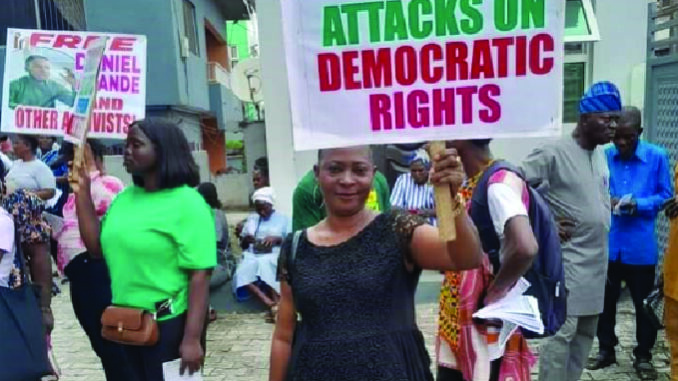
We demand the immediate and unconditional withdrawal of charges against Micheal Lenin and nine others, and the immediate and unconditional release of all individuals arrested in connection with the August protests yet to be charged. These include 39 who have been slammed in Kuje prison without being arraigned in court since 22 August, and Daniel Akande who is being held at the facility of the Inspector General of Police’s Intelligence Response Team in Abuja without trial since 2 September. There is also Khalid Aminu who has been in custody of the DSS without trial since the first week of August.

We also call on the police and other security operatives to stop the constant harassment of President of the Nigeria Labour Congress (NLC) Joe Ajaero and desist from the planned arrest of some socialist and left activists based in Abuja. We also demand the unfreezing of bank accounts of activists and organisations which have been barred in connection with #EndBadGovernance protests. Labour and pro-masses’ organisations should support these demands. End the atmosphere of intimidation and repression by the Tinubu government. Its descent to civil dictatorship must be resisted.

Moreover, we must highlight a glaring hypocrisy within the legal system. Corrupt politicians and other members of the thieving elite accused of serious offences often receive lenient bail conditions that starkly contrast with those imposed on ordinary citizens. This disparity underscores a systemic bias that favours the rich ruling elite who steal public wealth but penalises ordinary people for exercising their democratic rights.

We call on the labour movement, especially leadership of Nigeria Labour Congress (NLC) and Trade Union Congress (TUC), civil society organisations and human rights groups to practically lend weight and voice to ensuring that Michael Lenin and nine others who have been granted bail to regain freedom and demand the immediate and unconditional release of all in different detention facilities in connection with the #EndBadGovernance protests.

We specifically charge NLC President Joe Ajaero to walk the talk he made during a visit to the new President of the Nigeria Bar Association (NBA) as he was reported to have “reaffirmed the NLC’s commitment to working alongside the NBA in promoting the rights of workers and all Nigerians” (Punch, 14 September). The NLC must ensure that all those arrested and detained over #EndBadGovernance protests are released. Instructively, they include Eleojo Opaluwa, a regional officer of National Union of Electricity Employees (NUEE) and Vice Chair of NLC Kogi State council.

Tinubu is using the detention of activists and attacks on democratic rights to serve as deterrent to further mass protests. Working people and youth must fight for the freedom of detained protesters and prepared to join a future protest against Tinubu anti-poor policies.