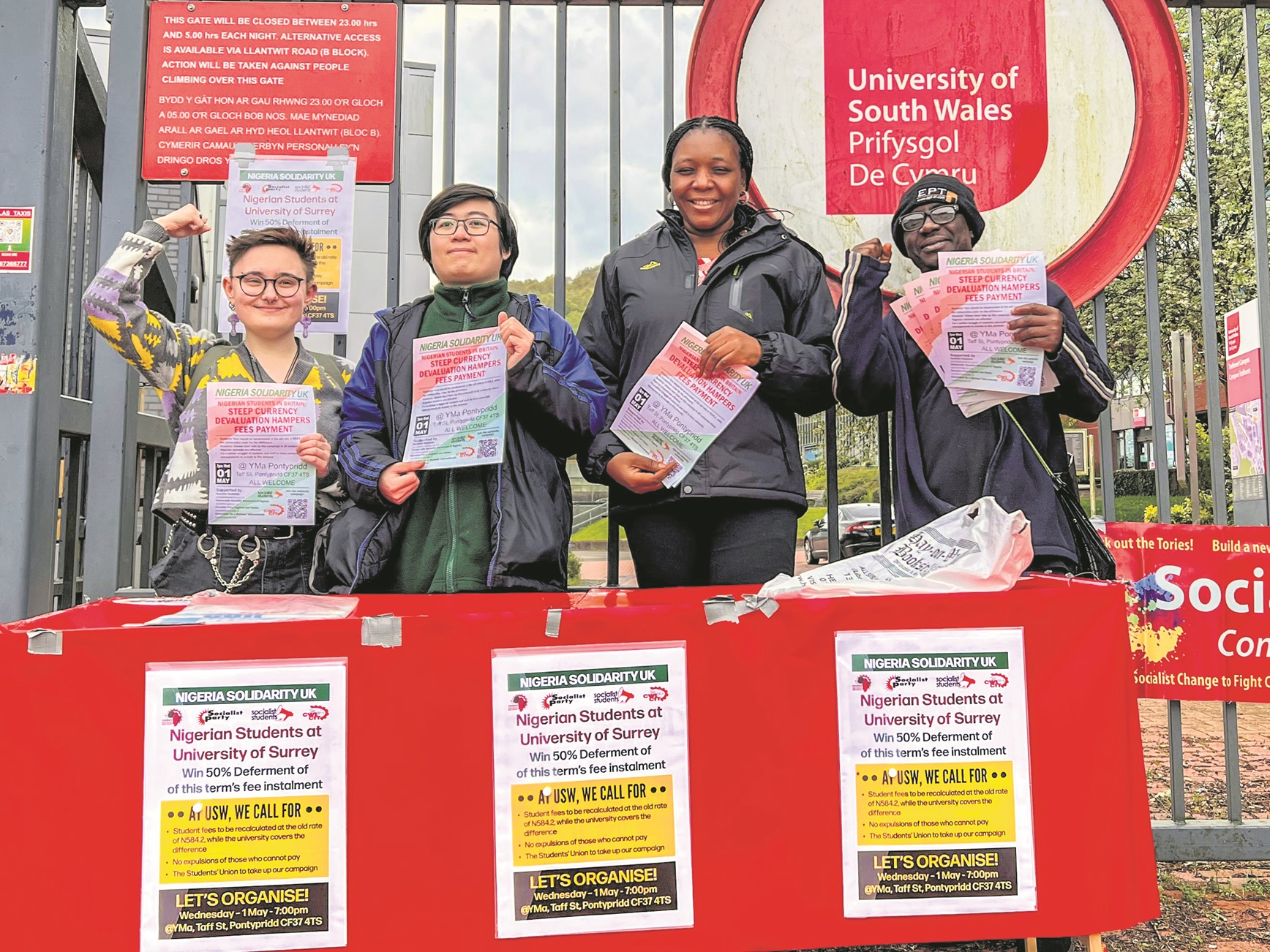
Campaigning against deportation of Nigerian students at University of South Wales
‘No exclusions for students who can’t pay’; ‘Extend payment to the end of courses’; ‘Allow students to pay at the old naira rate of N584’.
Those were demands on our placards, as our delegation of students and supporters made its way through the campus of the University of South Wales (USW) on 3 May.
We were carrying with us the good wishes of a number of others who – due to course commitments, work or nerves – could not be there. With the Nigerian currency worth a third of what it was a year ago, many students are finding it impossible to pay their fees on time.
We were heading to Ty Crawshay – the admin building at USW – named for the old mine and ironworks-owning family which working-class people rebelled against in the Merthyr Rising of 1831.
Student staff on reception looked a little scared when we said we were there to see the vice chancellor (VC).
We marched to the top of the building and found the VC wasn’t in. So, we handed in our letter, took photos, recorded a speech – and put the lot on social media.
Please send messages of support to our Socialist Party organised campaign.
If you’re a trade unionist, please say so in your message – and please ask your branch to support the campaign. Messages from those in UCU, Unison and Unite would be particularly useful. All will be forwarded to the vice chancellor at USW.
If you’re a Nigerian student or know someone who is, and this is an issue at your local uni, get in touch: contact@nigeriasolidarity.com
Nigerian international students are in a desperate situation.
As a result of the severe economic crisis in Nigeria, and drastic devaluation of the Nigerian currency, the naira, many students are unable to cover the eye-watering costs of living and studying in the UK.
This crisis was set in motion by the disastrous policies of the Nigerian president Bola Tinubu, whose government last year decided to ‘float’ the naira – essentially allowing the currency’s value to be determined by market forces for the first time in years. This policy instantly led to the biggest-ever collapse in the value of the naira.
300% increase
The naira has lost two-thirds of its value against the pound in less than a year. For Nigerian students in the UK, this means a 300% increase in the cost of tuition fees, rent, and other living costs.
Disgracefully, universities across the UK are moving to exclude Nigerian students who can no longer pay their tuition fees. This would effectively mean deportation, as students would no longer have a sponsoring institution for their visas.
In response to this threat, at the University of Surrey approached the university’s Nigerian Society, and helped launch a campaign to stop the expulsions.
The campaign began with a joint meeting, which agreed a set of demands aimed at university management:
Ensure no exclusions for Nigerian students who are unable to pay their tuition fees
Extend the payment period for Nigerian students struggling to pay their tuition fees
Allow students to pay their tuition fees at the pre-floatation naira rate of N584.20
As a way to galvanise support for these demands, and put pressure on management, the meeting also agreed an emergency protest for the following week. We decided to march through campus on 22 April, and deliver a joint letter to the vice-chancellor’s office, to put forward our demands, and request an in-person meeting between the vice-chancellor and representatives of the campaign.
Protesting works
Our campaign has shown that protesting wins! The university management has now said that it will allow Nigerian students to stay on at the university, if they pay 50% of their originally agreed fee instalment for this term. This is a welcome concession, and importantly gives us time to regroup, and plan the next steps for the campaign.
However, for any student who cannot afford 50% of their instalment, we must continue to demand no exclusions, while also continuing to raise the demand for students to pay fees at the old rate of naira. If necessary, we will organise future protests to back up these demands.
Spread to other unis
Another crucial way to strengthen our campaign at the University of Surrey is to spread these demands to other campuses. This crisis is affecting Nigerian students at universities around the UK. That’s why we will be reaching out to Nigerian societies around the country to initiate similar campaigns on their campus.
As part of our campaign, members in Surrey have also contacted campus trade unions which, like students, are in battle against management – in their case, over the threat of up to 140 job cuts.
Vice-chancellors cut jobs for the same reason that they charge international students ridiculously high tuition fees – to make up for a broken higher education funding model. That’s why we calls for a united movement of students and staff nationally to win fully funded, free education for all.
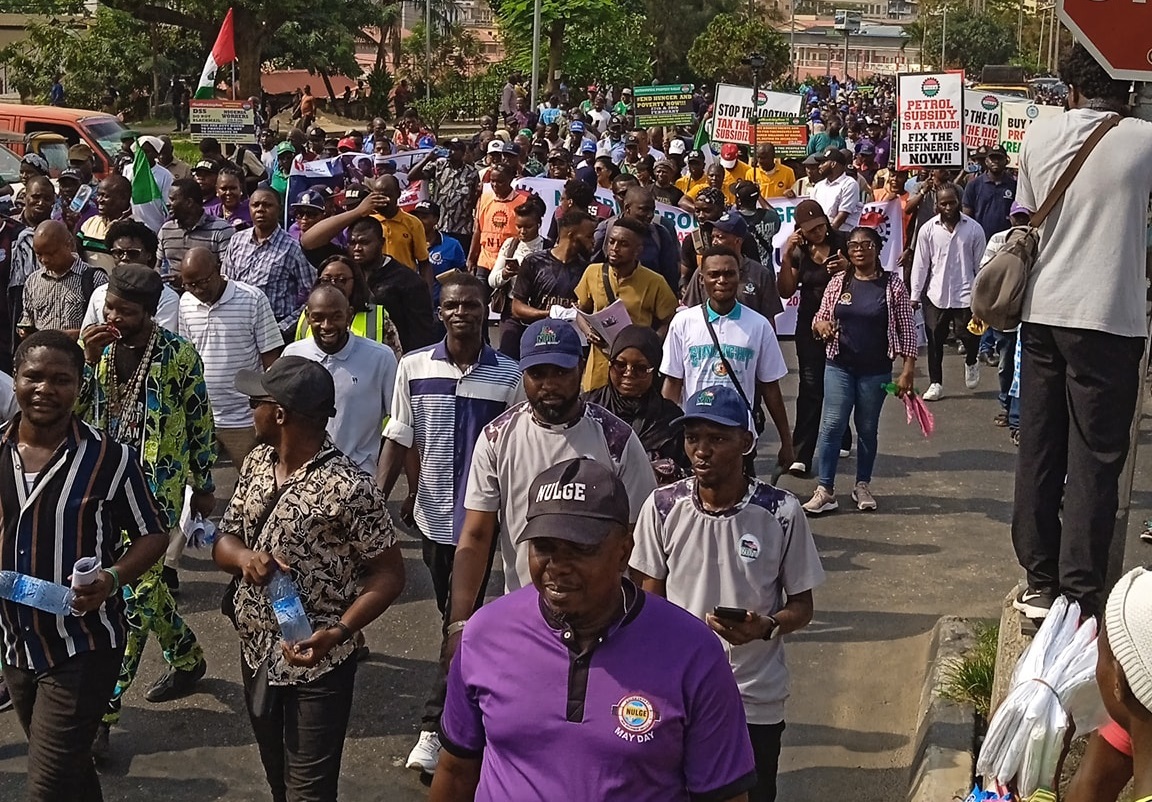
Protests in Nigeria against cost of living. Photo: DSM
Since Nigerian president Bola Tinubu came to power last May, he has launched relentless attacks on the masses in Nigeria through neoliberal capitalist ‘shock therapy’ policies, encouraged by the International Monetary Fund (IMF) and international capitalists.
This started with the immediate removal of fuel subsidies, sharply increasing the cost of transport and energy generation. He then floated the Nigerian currency, more than doubling the price of imports as the naira lost 70% of its value. The resultant inflation has escalated the crisis of underfunding in government services; for example in healthcare antibiotics prices increased by 1,100%.
Inflation has worsened hunger; the ministry of agriculture predicts that 31.5 million Nigerians will face acute hunger this year and many are now turning to eating reject rice grains previously used for fish feed. Domestic food growth has also been hindered by kidnapping and attacks by terrorists and violent gangs. Insecurity has only worsened since the inflation with more desperate acts like the recent looting of a warehouse and a stampede over rice killing seven people. With 46 academics in the capital dying due to hardship, it’s clear even traditionally secure professions aren’t immune to the suffering.
To fight back, there have been spontaneous protests, but organised workers should lead the movement. The Nigerian Labour Congress called two days of protests but cancelled the second day, despite getting no concessions from the government. The Democratic Socialist Movement of Nigeria (DSM) called for national strike action from the unions. If organised, this could force a reversal of policy, as was seen in the 2011 general strike in Nigeria.
But regardless of the trade union leadership’s inaction, the DSM, as part of the Joint Action Force, has vowed to continue action, despite the constant threat of violent repression by the Nigerian state.
And so solidarity action must also be taken by the Nigerian diaspora. Here Nigeria Solidarity, quickly organised a demonstration outside the Nigerian High Commission in London on 9 March, as a step towards building a solidarity movement of Nigerians and other workers.
The campaign echoes the calls of the DSM for an immediate end to Tinubu’s anti-poor policies. It calls for the return of the fuel subsidy to lower prices back to pre-29 May levels, for an increase in the national minimum wage to match the rate of inflation, and for a reversal of all anti-poor neoliberal policies. Nigeria has huge resources, yet they are used for the greed of a few. Join us as we campaign for them to be used for the benefit of the majority.
We are also campaigning on the issues affecting Nigerians here in Britain. The rapid devaluation of the naira left many students threatened with unenrolment as they were unable to pay their university fees which basically doubled overnight. Over the coming weeks we will be organising protests and meetings on campuses demanding that universities write off the increased burden of uni fees and accommodation costs caused by the devaluation of the naira.
Nigeria Solidarity Zoom meeting: Speakers include Peloala Adewale Democratic Socialist Movement Nigeria
7pm 25 March 2024
Meeting ID: 815 4306 7850 Passcode: 521693. All welcome




 Nigeria Solidarity